

How Long Does It Take to Get Monetized on YouTube? A 2026/2027 Study
How Long Does It Take to Get Monetized on YouTube?
For most new creators, getting monetized on YouTube is better thought of as a one-year-plus project than a 30-day challenge.
The strongest large-scale data we found suggests that the median channel takes about 16 months just to reach 1,000 subscribers, one of the main requirements for full YouTube ad monetization and to start earning on YouTube.
vidIQ analyzed 9,414 YouTube channels created after 2023 that had successfully crossed 1,000 subscribers. The median was roughly 16 months. Only 7.6% did it in under three months, while 64% took more than one year.
That does not mean every channel will take 16 months to get monetized. Some reach the YouTube Partner Program in a few weeks. Others need two, three, or even four years.
Our own Creator Studies review of 40 publicly reported monetization timelines found exactly that kind of spread.
The median in that success-story sample was about 4.75 months, while the average was 9.4 months because several creators took two to four years. Three-quarters reported getting monetized within one year.
There is an important warning attached to those numbers. People who become monetized quickly are much more likely to post a success story about it. A sample built from those posts will naturally make YouTube growth look faster than it is for the wider population.
That is why the larger 9,414-channel dataset is so useful.
If you are starting a YouTube channel from zero, a realistic planning range is roughly 12 to 24 months. A focused channel with strong videos can reach monetization in three to six months. A breakout video can shorten the process to weeks. A slower channel may need several years.
And once you actually qualify, the YouTube review itself is usually the shortest part of the process.
What Does “Monetized on YouTube” Actually Mean?
Before discussing the timeline, there is an important distinction.
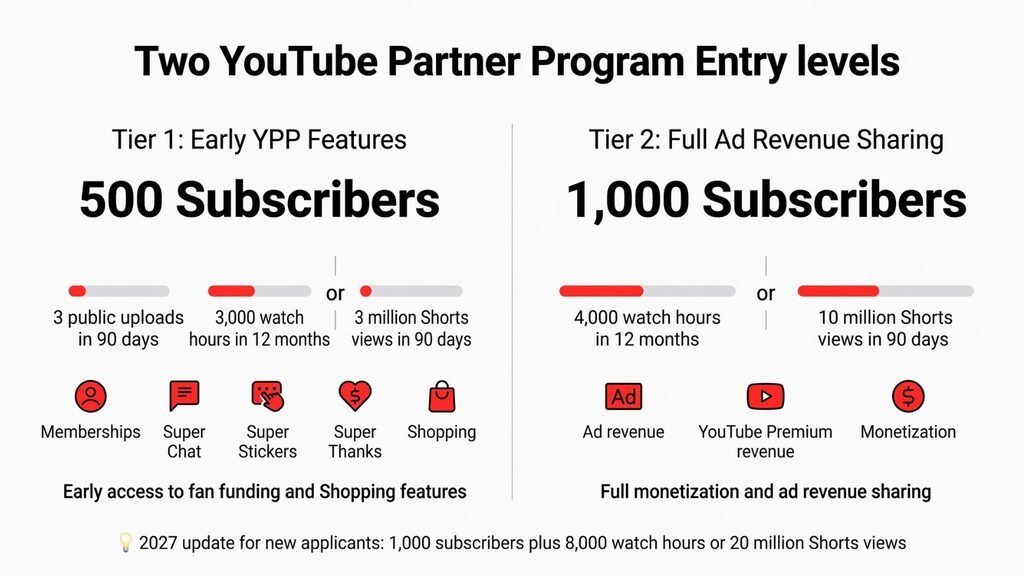
YouTube currently has two levels of YPP eligibility in countries where its expanded Partner Program is available.
As of August 26, 2026, creators can enter the expanded YouTube Partner Program with:
- 500 subscribers
- At least 3 public uploads in the previous 90 days
- Either 3,000 qualified public watch hours during the previous 12 months
- Or 3 million qualified Shorts views during the previous 90 days
That level can unlock features such as channel memberships, Super Chat, Super Stickers, Super Thanks, and certain Shopping features. It does not automatically unlock the standard ad revenue sharing most people mean when they say their channel is monetized.
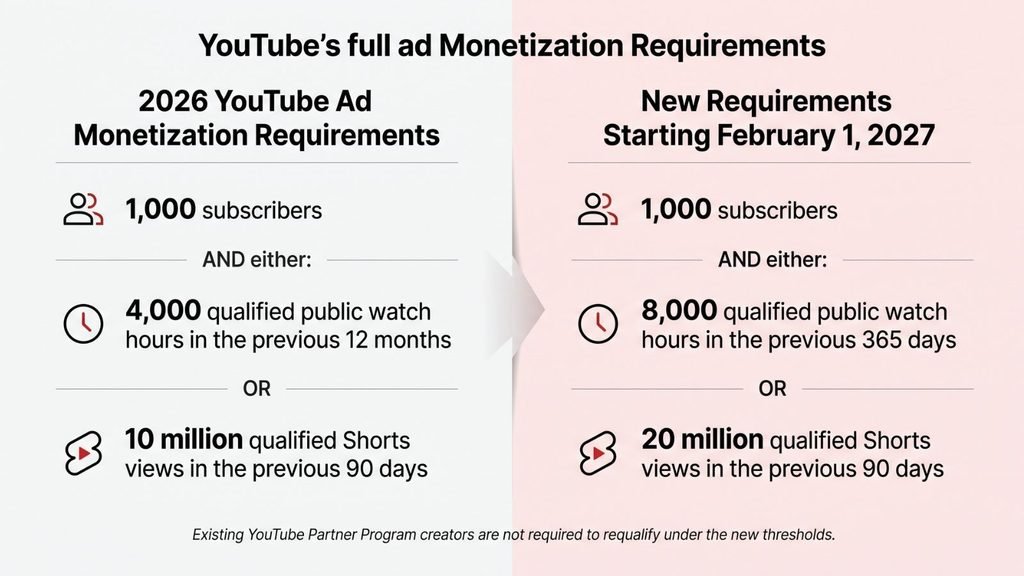
For full advertising and YouTube Premium revenue sharing in 2026, creators currently need:
- 1,000 subscribers
- Either 4,000 qualified public watch hours in the previous 12 months
- Or 10 million qualified public Shorts views in the previous 90 days
YouTube also requires creators to follow its monetization policies, live in an eligible country or region, have no active Community Guidelines strikes, enable two-step verification, have access to advanced features, and link an active AdSense for YouTube account.
So when we talk about “getting monetized” in this study, we are primarily talking about qualifying for YouTube’s advertising revenue sharing, not simply entering the lower 500-subscriber YPP tier.
The Real YouTube Monetization Timeline Has Two Parts
The question “How long does YouTube monetization take?” actually combines two completely different timelines.
Timeline 1: Reaching the eligibility requirements.
This can take weeks, months, or years.
Timeline 2: YouTube reviewing your application after you qualify.
This usually takes days or weeks.
The first timeline is overwhelmingly the bigger challenge.
YouTube officially says that after a creator accepts the YPP terms, links an active AdSense for YouTube account, and enters the review queue, the company will usually return a decision within about one month.
YouTube also warns that application volume, system problems, available review resources, or the need for multiple reviews can make the process longer.
In practice, many creators report much faster reviews.
In an August 2026 PartneredYouTube discussion, creators reported approvals in half a day, a few days, and about a week. Another August 2026 creator said both the AdSense and YPP review stages took about a day each.
A January 2026 discussion contained reports of one-day, three-day, and sub-24-hour reviews, although other creators said one to two weeks was normal in their experience.
There are also exceptions. Creators have reported applications remaining under review for a month or longer.
The useful rule is this: budget up to a month for the official review, but understand that a straightforward application may be approved in only a few days.
The months of work before applying are usually what determine the real monetization timeline.
The Best Data We Found Says 1,000 Subscribers Takes About 16 Months
YouTube does not publish an official average number of months required to become monetized.
That makes independent channel data particularly useful.
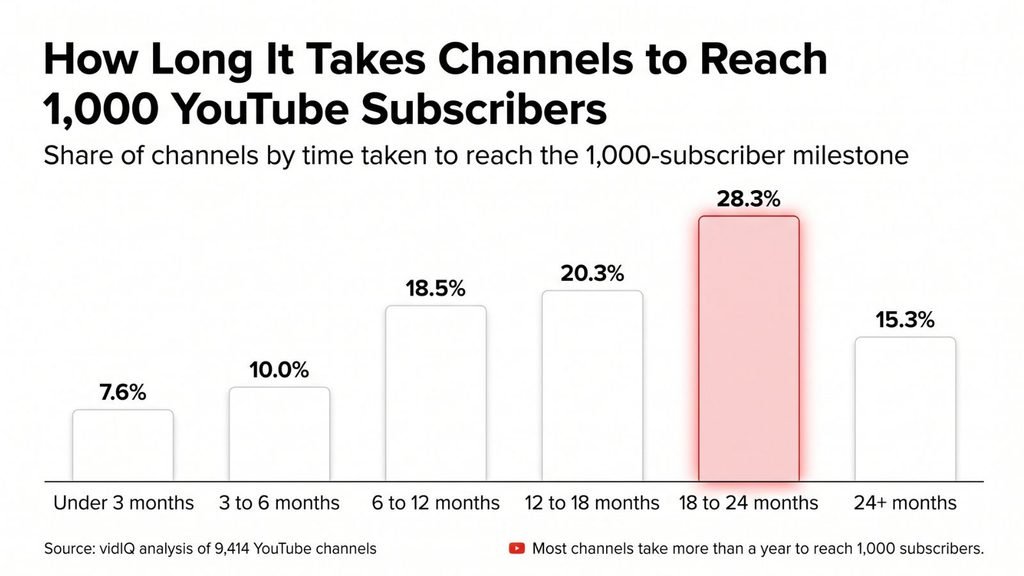
vidIQ studied 9,414 YouTube channels created after 2023 that recently reached 1,000 subscribers. Its February 2026 analysis found a median time of roughly 16 months.
Here is how those channels were distributed:
| Time to reach 1,000 subscribers | Share of channels |
|---|---|
| Under 3 months | 7.6% |
| 3 to 6 months | 10.0% |
| 6 to 12 months | 18.5% |
| 12 to 18 months | 20.3% |
| 18 to 24 months | 28.3% |
| 24 months or longer | 15.3% |
That means only 17.6% reached 1,000 subscribers within six months.
About 36% reached the milestone during their first year.
Approximately 64% took longer than a year.
The fastest 25% reached 1,000 subscribers in less than about 8.5 months. The slowest quarter needed nearly two years or longer.
This may be the most useful benchmark for a creator deciding what expectations to set.
A three-month monetization goal is possible. It is not normal.
A six-month goal is achievable for a strong channel. It is still considerably faster than the median.
Planning around roughly 12 to 24 months is far more consistent with the broader data.
Most Channels Need More Videos Than You Might Expect
Another large dataset helps explain why monetization commonly takes so long.
vidIQ separately analyzed more than 5.3 million channels that reached 1,000 subscribers.
Only about 10% reached 1,000 subscribers with fewer than 10 uploaded videos.
About 68% had published more than 40 videos by the time they crossed 1,000 subscribers.
The single largest group was creators who needed 150 videos or more, accounting for about 31% of the channels studied.
Think about what that means in calendar time.
A creator making one video each week needs about nine months to publish 40 videos.
At two videos a month, 40 videos represent roughly 20 months of publishing.
Publishing 150 videos at once a week would take almost three years.
Of course, the number of uploads alone does not cause growth. One exceptional video can produce more subscribers than 100 weak videos.
But the data makes one point difficult to ignore: the creators who monetize from their first few videos are unusual.
For many channels, the first dozens of uploads are the period when the creator learns which topics work, how to improve thumbnails, how to hold attention, and what viewers actually want.
Creator Studies Sample: 40 Real YouTube Monetization Timelines
Large datasets tell us what happens across thousands or millions of channels. Individual stories show how unpredictable the path can be.
For this study, Creator Studies reviewed public creator discussions from 2024 through August 2026 and recorded 40 completed channel monetization timelines.
We excluded comments from channels that had not yet reached monetization and reports where the timeline was too unclear to use. When an experienced creator described separate channels, each channel was treated as a separate timeline.
This is a convenience sample of self-reported success stories, not a random sample of YouTube. It should not be treated as an estimate of what every new channel will experience.
Still, the results are revealing. The 40 reports included channels monetized in as little as about one week and others that took two, three, or four years.
The results:
- Median: approximately 4.75 months
- Average: approximately 9.4 months
- Monetized within 1 month: 25%
- Monetized within 3 months: 47.5%
- Monetized within 6 months: 55%
- Monetized within 12 months: 75%
- Took longer than 12 months: 25%
Here are some of the timelines creators publicly reported:
| Reported time to monetization | Context |
| About 1 week | Experienced creator’s second channel after jumping on a trend |
| About 2 weeks | Creator reporting rapid 2025 monetization |
| 15 days | Experienced creator launching another channel |
| 20 days | Creator in a June 2026 discussion |
| About 3 weeks | Multiple creators reported timelines around three weeks |
| 1 month | One of three channels described by an experienced creator |
| 2 months | Creator whose video broke out early |
| About 67 days | Creator who started July 1 and monetized September 7 |
| About 2.5 months | Several creator reports fall near this range |
| 3 months | Multiple creators, including a creator’s successful second attempt |
| 4 months | A frequently reported timeline across several threads |
| 5 months | Creator who said a handful of videos drove most late growth |
| About 5.5 months | Creator starting in March and monetizing five to six months later |
| 6 months | One experienced creator’s channel |
| 7 months | Creator who started in late July and applied the following February |
| 8 months | Several creators reported reaching YPP near this point |
| 9 months | Multiple channels, including a gaming creator |
| 10 months | Tech repair and tutorial creator with roughly 80 videos |
| 13 months | Several creators reported timelines around one year |
| 15 months | Creator who reached monetization within one year and three months |
| 2 years | Multiple reports |
| About 2.5 years | Long-running creator report |
| 3 years | Multiple creators |
| 4 years | Creator posting roughly once per month |
Several recent individual stories add useful detail.
One tech repair and tutorial creator began uploading on May 29, 2025 and reported being monetized on March 1, 2026, about 10 months later. The creator had around 80 videos and had already passed 6,000 watch hours before finally reaching 1,000 subscribers.
Another creator reported becoming monetized after eight months, with only three or four videos providing most of the growth during the final month.
Another reached monetization after 13 months and 33 videos, helped by a video that eventually reached about 150,000 views.
One particularly useful example comes from a creator who had already tried YouTube once. The first channel required three years to become monetized. After changing niches and using what they had learned, the creator’s next channel did it in three months.
Made With Lau provides a well-documented example outside Reddit. The Cantonese cooking channel launched in September 2020 and reached YouTube’s monetization requirements about two and a half months later. Randy Lau later described being surprised by how quickly the channel crossed the threshold.
Creator Your Friend Andy reported starting a finance channel in June 2020, reaching 1,000 subscribers in about six months, and becoming officially monetized in about seven months.
Another creator, Scotts PC, reported needing 13 months to reach 1,000 subscribers, by which point the channel had around 8,000 watch hours.
The lesson from these examples is not that four or five months is the true YouTube average.
The lesson is that monetization timelines have an enormous range, and highly visible success stories heavily favor the faster end of that range.
Why Reddit Makes YouTube Monetization Look Faster
Our 40-case sample produced a 4.75-month median.
The much larger vidIQ dataset produced a 16-month median just to reach 1,000 subscribers.
Why is there such a large difference?
Selection bias is the most likely explanation.
A person who starts a channel and gets monetized in 20 days has an unusual story. That creator has a strong reason to post about it.
Someone who crosses the threshold in three months may do the same.
Meanwhile, thousands of creators slowly publishing videos for 14, 18, or 24 months are less likely to create celebratory posts during the middle of that journey.
And creators who abandon YouTube before monetizing never appear in a study containing only successful monetization stories.
This is why anecdotal creator communities can unintentionally create unrealistic expectations.
Fast monetization stories are real. They are simply not the same thing as an average outcome.
The large-scale subscriber data should carry more weight when setting expectations.
Subscribers or Watch Hours: Which Takes Longer?
Full YouTube ad monetization currently requires 1,000 subscribers plus one of the viewing thresholds.
For long-form channels, that means 4,000 qualified public watch hours during the previous 12 months.
That equals 240,000 minutes watched.
How difficult that is depends heavily on average view duration.
If the average viewer watches three minutes, a channel would need roughly 80,000 qualifying views to produce 4,000 hours.
At a five-minute average view duration, it would take about 48,000 views.
At eight minutes, it would take around 30,000 views.
These are simplified examples because real channels have videos with different lengths and retention rates, but they show why long-form videos can build watch time surprisingly quickly once a channel gets consistent traffic.
For some creators, subscribers become the bottleneck.
The tech repair creator in our sample had already passed 6,000 watch hours when the channel finally reached 1,000 subscribers.
For other channels, the reverse happens. One creator reported reaching 1,000 subscribers months before finally crossing the 4,000-hour mark.
This matters because reaching one requirement early does not guarantee the other will arrive soon afterward.
Is It Faster to Monetize With Shorts?
Shorts can grow a subscriber count very quickly, but the Shorts path to full ad monetization has a demanding viewing requirement.
As of August 2026, the full YPP Shorts path requires 10 million qualified public Shorts views within 90 days, along with 1,000 subscribers.
That works out to an average of more than 111,000 qualified Shorts views per day for 90 days.
Long-form creators instead need 4,000 qualified watch hours in 12 months.
Neither route is automatically easier.
A Shorts channel capable of repeatedly reaching hundreds of thousands or millions of views may cross the threshold very quickly.
A creator producing useful evergreen videos may find that accumulating 4,000 long-form watch hours is much more achievable.
One important rule also catches some new creators by surprise: watch time generated inside the Shorts Feed does not count toward the 4,000-hour long-form requirement.
That means a channel can accumulate millions of Shorts views and thousands of subscribers while still having very little progress toward the long-form watch-hour threshold.
How Long Should a New YouTuber Realistically Plan For?
Based on the large-sample subscriber data, public creator reports, and the current YPP requirements, this is a more useful way to think about the timeline.
Under 3 Months: Exceptionally Fast
This happens.
Usually there is a strong reason: a breakout video, an excellent niche fit, previous creator experience, an existing audience, unusually high publishing volume, or a well-timed trend.
In vidIQ’s 9,414-channel sample, only 7.6% reached 1,000 subscribers in under three months.
Do not build your business plan around this outcome.
3 to 6 Months: Fast
A creator can absolutely become monetized in this range.
Our public success-story sample contained many examples between three and six months.
But the larger dataset shows that only another 10% of channels reached 1,000 subscribers during the three-to-six-month period.
A six-month target is therefore ambitious rather than average.
6 to 12 Months: Strong Progress
This is a reasonable goal for an organized creator publishing consistently, testing ideas, and improving quickly.
It is still faster than the median 1,000-subscriber timeline in the larger dataset.
Reaching monetization within the first year should be viewed as a strong result.
12 to 24 Months: The Most Realistic Planning Window
This is the range we would use when creating a realistic forecast for a new channel with no existing audience.
The vidIQ data places its median at about 16 months, and the largest single time band was 18 to 24 months, representing 28.3% of the channels studied.
That does not mean creators should simply publish for two years and hope.
It means they should have enough runway to spend months learning before expecting the channel to generate advertising income.
More Than 24 Months: Still Normal
About 15.3% of channels in the 9,414-channel dataset took at least two years just to reach 1,000 subscribers.
Our creator sample also contained two-year, three-year, and four-year monetization stories.
Slow growth does not automatically mean a channel can never work.
But after dozens of videos with little improvement, creators should be willing to reconsider topics, positioning, titles, thumbnails, format, and audience fit rather than simply repeating the same strategy.
A Major YouTube Monetization Change Is Coming in 2027
Anyone starting a YouTube channel now should know about a major change that YouTube announced on August 10, 2026.
Beginning February 1, 2027, YouTube says new creators seeking entry into YPP for advertising and Premium revenue sharing will need 1,000 subscribers plus either 8,000 qualified watch hours during the previous 365 days or 20 million qualified Shorts views during the previous 90 days.
That doubles the current viewing thresholds for new applicants.
YouTube says creators who are already in YPP will not lose their status because of the new entry requirements. The lower thresholds for fan funding and Shopping will also remain unchanged.
For creators starting in late 2026, this change could materially increase the time required to reach full ad monetization.
So, How Long Does YouTube Monetization Really Take?
There is no single YouTube monetization timeline that applies to every channel.
But there is enough data to set much better expectations than “it depends.”
The best large-scale benchmark we found is about 16 months to reach 1,000 subscribers. That does not include any extra time needed if the channel has not yet reached its watch-hour or Shorts-view requirement.
A creator with strong audience fit and a breakout video can get monetized in a few weeks or months.
Our review found real public examples at one week, two weeks, one month, two months, three months, and four months.
It also found creators who needed one year, two years, three years, and four years.
Once a channel meets the requirements, YouTube officially says the YPP review typically takes about one month, although many current creators report decisions within a few days.
For a creator starting from zero, the most useful expectation is therefore:
Plan for roughly 12 to 24 months to reach YouTube monetization, work toward doing it faster, and treat anything under six months as an unusually strong result rather than the standard.
The biggest mistake is expecting revenue too early and interpreting six months without monetization as failure.
The data suggests something very different.
For most creators, six months is still early.
Sources
Primary Sources
YouTube Help: YouTube Partner Program overview and eligibility
URL: YouTube Partner Program overview and eligibility
Supported: Current 1,000-subscriber, 4,000-watch-hour and 10-million-Shorts-view requirements; eligibility rules; qualified watch time; review process and typical one-month review time.
Publication date: Not listed
Access date: August 26, 2026
YouTube Help: Overview of the Expanded YouTube Partner Program
URL: Expanded YouTube Partner Program
Supported: 500-subscriber early YPP tier, 3,000 watch hours, 3 million Shorts views, fan funding and Shopping access.
Publication date: Not listed
Access date: August 26, 2026
YouTube Blog: New Opportunities to Earn and Changes to the YouTube Partner Program
URL: YouTube Partner Program changes for 2027
Supported: February 1, 2027 changes to YPP ad and Premium entry thresholds and treatment of existing YPP creators.
Publication date: August 10, 2026
Access date: August 26, 2026
Third-Party Sources
vidIQ: How to Get Free YouTube Subscribers: Reach 1,000 Real Subs Fast
URL: vidIQ 1,000 subscriber study
Supported: Analysis of 9,414 channels, 16-month median to 1,000 subscribers, percentile ranges, and time distribution.
Updated: February 11, 2026; reviewed August 14, 2026
Access date: August 26, 2026
vidIQ: How Many Videos Does It Take to Get 1,000 Subscribers on YouTube?
URL: vidIQ 5.3 million channel study
Supported: Analysis of more than 5.3 million channels, including the share requiring more than 40 or 150 videos to reach 1,000 subscribers.
Publication date: June 9, 2025
Access date: August 26, 2026
Reddit, r/NewTubers: How Long Did It Take You to Monetise Your Channel?
URL: August 2026 creator timeline discussion
Supported: Multiple self-reported monetization timelines ranging from weeks to years.
Publication date: August 19, 2026
Access date: August 26, 2026
Reddit, r/PartneredYoutube: How Long Did It Take You to Get Monetized?
URL: June 2026 creator timeline discussion
Supported: Multiple creator timelines used in the Creator Studies sample.
Publication date: June 23, 2026
Access date: August 26, 2026
Reddit, r/PartneredYoutube: Did Any of You Start in 2024 or 2025 and Get Monetized?
URL: 2025 monetization timeline discussion
Supported: Creator timelines ranging from one month to two years.
Publication date: June 21, 2025
Access date: August 26, 2026
Reddit, r/NewTubers: My Journey to Getting Monetized
URL: Ten-month tech channel monetization case study
Supported: Ten-month monetization example, roughly 80 videos, and watch hours reached before subscriber requirement.
Publication date: May 15, 2026
Access date: August 26, 2026
Feisworld: Randy Lau, Growing Made With Lau
URL: Made With Lau creator interview
Supported: Made With Lau reaching the YouTube monetization threshold approximately two and a half months after launch.
Publication date: 2021
Access date: August 26, 2026