

YouTube Partner Program Changes for 2027: What Creators Need to Know
YouTube is raising monetization thresholds, changing how Shorts creators qualify for revenue, expanding Premium Lite, and introducing new rules for staying active in the YouTube Partner Program.
YouTube has announced its most significant changes to the YouTube Partner Program since 2018, and the new rules take effect on February 1, 2027.
The biggest headline is simple: new creators will need twice as many watch hours or Shorts views to unlock advertising and YouTube Premium revenue sharing.
But that is only part of the story.
YouTube is also introducing a new ongoing performance requirement for Shorts revenue, expanding Premium Lite, creating new Shorts monetization opportunities, changing its definition of an active YPP channel, and requiring creators to accept updated monetization agreements.
YouTube says more than 3 million creators are currently part of YPP and that it expects to pay creators more in 2027 than it did in 2026. The company describes these updates as a way to reward active creators while investing in new creator revenue programs.
For creators, however, the effects will depend heavily on where they are in their YouTube journey.
An established long-form creator may notice very little beyond accepting new terms. A new creator trying to qualify for advertising will face a much higher bar. A Shorts creator who is already monetized could remain in YPP but temporarily lose Shorts revenue if views fall below the new minimum.
Here is exactly what is changing, what is staying the same, and how creators should prepare.
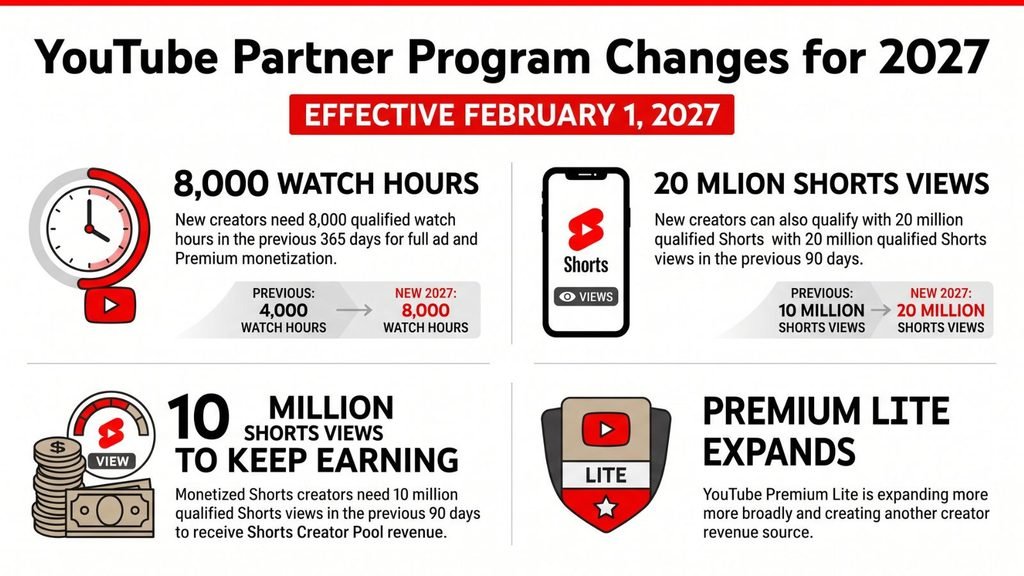
YouTube Partner Program Changes for 2027 at a Glance
Starting February 1, 2027, YouTube is making several major changes to the YouTube Partner Program:
- New creators will need 1,000 subscribers and 8,000 qualified watch hours in the previous 365 days to unlock ads and Premium revenue through long-form content.
- Alternatively, new creators can qualify with 1,000 subscribers and 20 million qualified Shorts views during the previous 90 days.
- The current thresholds are 1,000 subscribers plus either 4,000 qualified watch hours or 10 million qualified Shorts views.
- Existing YPP creators are not required to meet the new 8,000-hour or 20-million-view entry thresholds again.
- Shorts creators will need 10 million qualified Shorts views during the previous 90 days to receive Shorts Creator Pool ad and subscription revenue each month.
- Creators who fall below that Shorts requirement remain in YPP and can continue earning from other eligible monetization features on YouTube.
- Early YPP access for fan funding and Shopping remains available at 500 subscribers, along with the existing watch-time or Shorts requirements.
- Premium Lite will expand to every country where YouTube Premium is offered.
- New Shorts incentive programs and directly targeted Shorts advertising will create additional earning opportunities on YouTube.
- YouTube is introducing clearer activity requirements for remaining active in YPP.
- Creators must review and accept applicable updated monetization terms by January 31, 2027 to avoid interruptions to earnings.
The changes are confirmed by YouTube and are not proposed rules or industry rumors.
The Full YouTube Monetization Threshold Is Doubling
For creators who are not already fully monetized, the most important 2027 change is the higher threshold for advertising and Premium revenue sharing.
Until January 31, 2027, creators can qualify for full YPP monetization through either of these paths:
- 1,000 subscribers plus 4,000 qualified public watch hours during the previous 12 months
- 1,000 subscribers plus 10 million qualified Shorts views during the previous 90 days
Beginning February 1, 2027, those requirements become:
- 1,000 subscribers plus 8,000 qualified watch hours during the previous 365 days
- 1,000 subscribers plus 20 million qualified Shorts views during the previous 90 days
The subscriber requirement remains at 1,000. The watch-hour and Shorts-view requirements both double.
This is a major change because the 4,000-hour requirement has been a central part of YouTube monetization since 2018.
When YouTube changed YPP in 2018, it established the familiar requirement of 1,000 subscribers and 4,000 hours of watch time. At that time, YouTube said higher standards would help it identify channels that contributed positively to the platform and protect advertisers from inappropriate or abusive content.
The 2027 change effectively raises that bar again.
For a creator pursuing long-form monetization, 8,000 hours equals 480,000 minutes of qualified viewing during a rolling year.
A channel whose average viewer watches five minutes would need roughly 96,000 qualifying views to generate that amount of watch time. A channel averaging 10 minutes per viewer could reach the same watch-time total with roughly 48,000 views.
Those examples are simplified because actual viewing patterns vary, but they demonstrate something important: retention and watch time will become even more valuable for creators trying to reach full monetization.
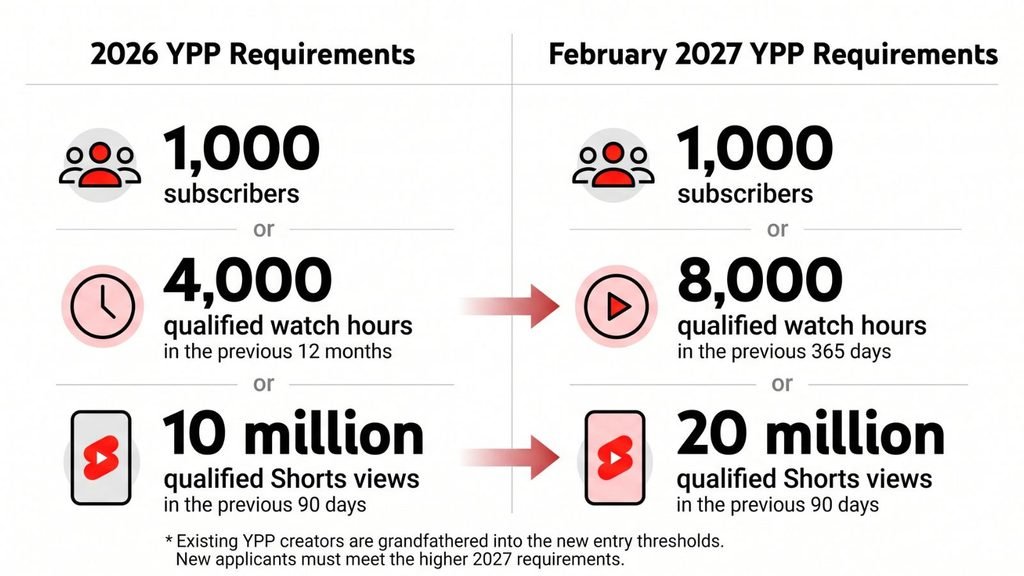
Existing YPP Creators Are Grandfathered Into the New Entry Threshold
One of the biggest sources of confusion around the announcement is whether existing creators must suddenly reach 8,000 watch hours or 20 million Shorts views to remain monetized.
They do not.
YouTube explicitly says that creators who are already in YPP will not lose their YPP status simply because they do not meet the new full-monetization entry thresholds.
For example, imagine a long-form creator who is already monetized but generated only 5,000 qualified watch hours during the previous year.
That creator will not suddenly lose long-form advertising revenue on February 1, 2027 because the new entry requirement is 8,000 hours.
The new 8,000-hour and 20-million-Shorts thresholds apply to new applicants seeking advertising and Premium revenue sharing.
That grandfathering makes the transition much less disruptive for established long-form creators than YouTube’s 2018 YPP change, which ultimately applied its new requirements to existing channels as well.
There is, however, an important exception involving Shorts revenue.
Shorts Creators Must Maintain 10 Million Qualified Views
The biggest ongoing change for existing creators affects YouTube Shorts.
Starting February 1, 2027, a creator must have 10 million qualified Shorts views during the previous 90 days to receive advertising and YouTube Premium revenue from the Shorts Creator Pool each month.
This is different from the new 20-million-view entry threshold.
The distinction matters:
20 million qualified Shorts views in 90 days:
This is the new Shorts path for a creator applying to unlock full advertising and Premium monetization beginning February 1, 2027.
10 million qualified Shorts views in 90 days:
This is the ongoing threshold a YPP creator must maintain to earn from the Shorts Creator Pool.
If an existing monetized Shorts channel falls below 10 million qualified views, YouTube says the channel will remain in the YouTube Partner Program.
The creator can still earn from eligible long-form videos, memberships, Super Thanks, Shopping, and other available YPP products.
Shorts Creator Pool revenue will resume when the creator again crosses 10 million qualified Shorts views during the applicable 90-day period.
This creates a significant change in the economics of Shorts.
Until now, reaching full YPP eligibility opened Shorts revenue sharing without an ongoing 10-million-view performance requirement of this kind.
Beginning in 2027, Shorts revenue becomes more directly tied to maintaining large-scale recent viewership.
For smaller Shorts channels, that makes diversification more important. A creator may be inside YPP while still being ineligible for Shorts Creator Pool payouts during a particular period.
What Counts as a “Qualified” YouTube View or Watch Hour?
YouTube is also standardizing its language around qualified watch hours and qualified Shorts views.
The terminology matters because not every view shown in a creator’s general analytics will necessarily count toward a YPP threshold.
For long-form videos, qualified watch hours generally come from public long-form videos, podcasts, and eligible archived livestreams.
YouTube says the following do not count toward YPP watch-hour thresholds:
- Private videos
- Unlisted videos
- Deleted videos
- Videos viewed through advertising campaigns
- Watch time from Shorts
- Livestreams that are not archived
For Shorts, qualified views must come from public Shorts in the Shorts Feed and must be engaged views.
YouTube defines an engaged Shorts view for this purpose as a viewer staying beyond the initial seconds. Loops are not included.
Private, unlisted, and deleted Shorts do not qualify. Neither do views generated through advertising campaigns, long-form views, or image posts shown in the Shorts Feed.
This distinction will become especially important when creators are working toward 20 million Shorts views.
A channel’s headline view count may not perfectly match the number YouTube considers qualified for monetization eligibility.
Creators should therefore use the Earn section of YouTube Studio and the appropriate Analytics metrics rather than estimating eligibility from public view counts alone.
Early Access to YPP at 500 Subscribers Is Not Going Away
The higher 2027 requirements do not mean every creator needs 1,000 subscribers and 8,000 hours before earning anything through YouTube.
YouTube operates a lower entry level of YPP that gives eligible creators earlier access to several fan-funding and Shopping features.
Those thresholds remain unchanged.
Eligible creators can still enter this earlier stage with:
- 500 subscribers
- The required recent public uploads
- 3,000 qualified watch hours during the previous 365 days, or
- 3 million qualified Shorts views during the previous 90 days
Depending on eligibility and location, this stage can unlock features such as channel memberships, Super Chat, Super Stickers, Super Thanks, and certain YouTube Shopping features.
The higher 8,000-hour and 20-million-view requirements are specifically about reaching the level that includes advertising and YouTube Premium revenue sharing.
That distinction is important for smaller creators.
YouTube is making ad-supported monetization harder to reach while keeping its lower-level fan monetization path available.
For some creators, that could make direct audience support, products, affiliate revenue, and brand partnerships more important during the period between reaching 500 subscribers and qualifying for advertising.
YouTube Is Expanding Premium Lite Worldwide
Another major part of the 2027 YPP update is the expansion of YouTube Premium Lite to every country where YouTube Premium is available.
Premium Lite is YouTube’s lower-priced alternative to the full Premium membership.
The product has evolved significantly since its wider pilot began in 2025. YouTube added background playback and downloads for most eligible videos in 2026.
Premium Lite now allows subscribers to watch much of YouTube with fewer advertising interruptions while also offering offline and background viewing for most eligible content. Ads can still appear on areas such as music content, Shorts, search, and browsing.
For creators, the important part is the revenue model.
YouTube says:
- A pool representing 60% of net Premium Lite subscription revenue will be used in the Premium Lite creator revenue system.
- A pool representing 30% of net YouTube Premium subscription revenue applies to the standard Premium offering.
- Those pools are distributed based on member viewing activity.
- Creators then receive the standard applicable revenue share, including 55% for long-form content and 45% for Shorts.
It would be incorrect to say that creators simply receive 60% of every Premium Lite subscription.
The 60% figure describes the amount of net subscription revenue allocated into the applicable creator pool before the subsequent distribution and creator revenue share calculations.
YouTube also says that, based on 2026 performance, creators on average earned more from a Premium subscriber than from the same user when that viewer was supported by advertising.
For creators with substantial long-form viewing, Premium Lite therefore has the potential to become a more meaningful portion of YouTube revenue as availability expands.
YouTube Is Creating New Ways to Monetize Shorts
The 10-million-view requirement could reduce Shorts Creator Pool earnings for some smaller and mid-sized channels, but YouTube is pairing that change with new monetization programs.
The company says it plans to introduce incentives that may include:
- Bonuses connected with YouTube Shopping
- Production credits or incentives related to brand deals
- Earnings boosts connected with cultural trends or trend participation
YouTube has not yet published complete eligibility criteria for these programs. It says eligible creators will receive information about opting in as individual programs launch.
Creators should therefore be careful about treating these incentives as guaranteed replacements for Shorts advertising revenue.
As of August 27, 2026, several important details remain unknown, including how large the incentives will be, how many creators will qualify, how often campaigns will run, and how payouts will be calculated.
There is also another new Shorts advertising opportunity that could matter for commercially attractive channels.
Directly Targeted Shorts Ads
YouTube is updating its monetization terms to support Shorts ads that advertisers can target to a very small group of specific channels.
If an advertiser targets five or fewer channels, eligible creators can receive 45% of the revenue from that placement, in addition to their normal Shorts Creator Pool earnings.
This is notable because the normal Shorts model pools advertising revenue.
Under the standard Shorts system, advertising shown between Shorts is collected into a pool. YouTube accounts for factors such as music licensing, allocates Creator Pool revenue based on eligible engaged views, and creators receive 45% of their allocated share.
Directly targeted Shorts advertising creates a more direct relationship between advertiser demand for a particular creator and that creator’s earnings.
For creators with clearly defined audiences and strong advertiser appeal, that could become an important new revenue source.
YouTube Is Changing What Counts as an Active YPP Channel
YouTube is also introducing more specific rules for determining whether a monetized channel remains active.
Starting February 1, 2027, YouTube says a channel can be considered active if it meets at least one of these requirements:
- 1,000 qualified watch hours during the previous 365 days
- 1 million qualified Shorts views during the previous 90 days
- Two long-form video uploads or five Shorts uploads every 90 days
YouTube says creators who fall below the activity requirements will receive an extended 90-day period to restore active status by meeting specified watch-hour or Shorts-view requirements.
This is different from the current language around inactive channels.
Before the 2027 change, YouTube stated that it may turn off monetization on channels that had not uploaded a video or posted to the Posts tab for six months or longer.
The new system gives creators more defined ways to demonstrate activity across different formats.
For many active creators, this requirement should be easy to satisfy.
It may matter more for creators with large evergreen libraries who upload infrequently, creators taking extended breaks, or channels that generate modest current traffic from older videos.
Every Monetized Creator Needs to Review the New YPP Terms
Even creators who are already safely inside YPP have something they need to do.
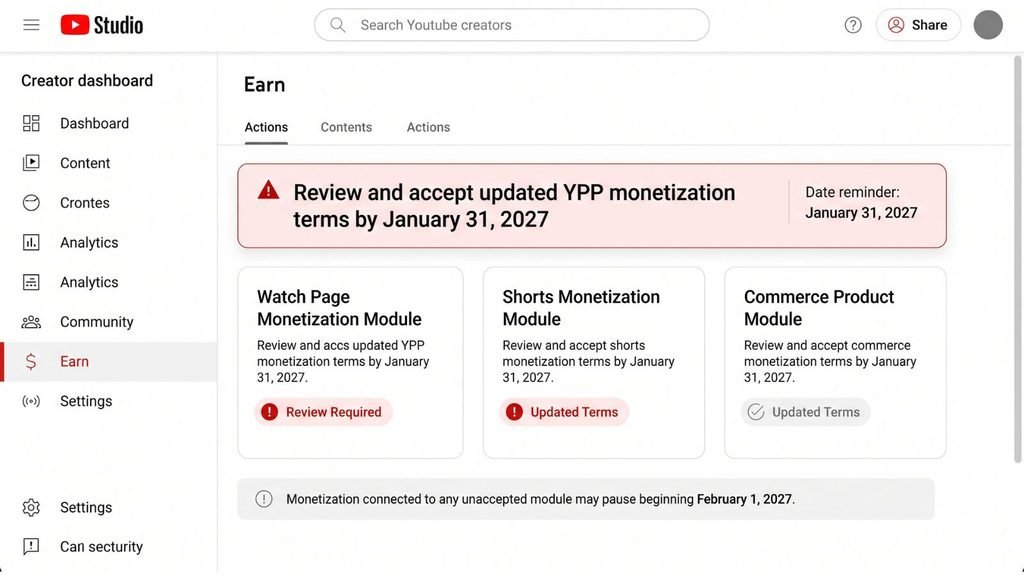
YouTube is updating its monetization agreements and says creators should accept the applicable new terms in YouTube Studio by January 31, 2027.
These can include:
- Watch Page Monetization Module
- Shorts Monetization Module
- Commerce Product Module, where applicable
If a creator does not accept an updated module by the deadline, YouTube says the creator will stop earning from the monetization features connected with that module beginning February 1, 2027.
Missing the deadline does not automatically remove the channel from YPP.
Creators can regain access to the affected monetization features after accepting the required terms.
Creators who joined fan-funding products before 2023 should pay particular attention.
Some may still be operating under the older Commerce Product Addendum. YouTube is moving those creators to its current Commerce Product Module.
YouTube says the move does not change fan-funding eligibility, how the products work, or the applicable revenue-sharing rates.
For reference, YouTube’s current standard revenue share under the Commerce Product Module is 70% of net revenue from channel memberships, Super Chat, Super Stickers, and Super Thanks.
What the 2027 Changes Mean for Different Types of Creators
The effects of the new YouTube Partner Program rules will not be equal for everyone.
New Long-Form Creators
New long-form creators face the clearest challenge.
The required watch time for full advertising and Premium monetization is doubling from 4,000 to 8,000 qualified hours.
That puts more weight on:
- Audience retention
- Longer viewing sessions
- Searchable evergreen videos
- Strong video packaging
- Returning viewers
- Playlists and related content that encourage additional viewing
Creators who are approaching 4,000 hours before the end of 2026 have a strong reason to monitor their eligibility closely rather than assuming the same threshold will remain available indefinitely.
Existing Long-Form YPP Creators
For an active creator already earning from long-form advertising, the impact should be much smaller.
The creator does not need to reach 8,000 hours again simply because the entry threshold changes.
The main tasks are staying active under YPP rules and accepting the new monetization terms.
Shorts-First Creators
Shorts-first creators face the largest structural change.
New creators need 20 million qualified Shorts views in 90 days to reach full ad and Premium monetization through the Shorts path.
Once monetized, creators need 10 million qualified Shorts views in the previous 90 days to participate in Shorts Creator Pool revenue for a given month.
That means a Shorts creator’s YPP membership and Shorts advertising eligibility can become two separate things.
A creator can remain a YouTube Partner while temporarily receiving no Shorts Creator Pool revenue.
Multi-Format Creators
Creators publishing both Shorts and long-form content may have more flexibility.
If Shorts revenue pauses because recent Shorts views fall below 10 million, eligible long-form advertising can continue.
This strengthens the business case for using Shorts as one part of a wider YouTube strategy rather than relying on Shorts Creator Pool revenue alone.
It also gives creators more ways to generate revenue through memberships, products, sponsorships, Shopping, Premium viewing, and long-form advertising.
Why Is YouTube Making These Changes?
YouTube says the Partner Program has more than 3 million participating creators and calls the 2027 update its first significant YPP change since 2018.
The platform says it now receives more than 200 billion daily Shorts views, while viewers watch more than 1 billion hours of YouTube on television screens each day.
That scale changes the economics of the platform.
YouTube says the higher thresholds and revised Shorts model will allow it to invest in creator incentive programs and support different creator business models.
The company also says its overall creator investment is not being reduced and that it expects to pay creators more in 2027 than in 2026.
That does not mean every individual creator will earn more.
Some creators could benefit from Premium Lite, targeted Shorts advertisements, new incentives, or stronger subscription revenue.
Others, particularly smaller Shorts creators and new channels pursuing full advertising monetization, may face a more difficult path.
The broader direction is clear: YouTube is putting more emphasis on sustained audience activity and multiple creator revenue streams rather than treating basic ad revenue as the only path to a creator business.
What Creators Should Do Before February 2027
Creators do not need to completely rebuild their strategy because of these changes, but there are several practical steps worth taking.
First, check YouTube Studio > Earn and understand exactly where your channel stands against the current and future thresholds.
If you are close to the existing full-monetization threshold but not yet inside YPP, the February 1, 2027 change makes reaching eligibility before the new rules take effect especially important.
Second, Shorts creators should begin paying closer attention to their rolling 90-day qualified view total, not just lifetime views or views on individual viral Shorts.
Third, creators should build revenue streams beyond a single source.
Depending on the channel, that may include:
- Long-form advertising
- YouTube Premium revenue
- Channel memberships
- Super Chat, Super Stickers, or Super Thanks
- YouTube Shopping
- Affiliate revenue
- Brand partnerships
- Products or services owned by the creator
Fourth, watch for the updated YPP agreements inside YouTube Studio and accept the modules you intend to use before January 31, 2027.
Finally, follow YouTube’s announcements regarding the new Shorts incentive programs. Important details about eligibility and payouts had not yet been released as of August 27, 2026.
Frequently Asked Questions About the 2027 YouTube Partner Program
What are the YouTube monetization requirements in 2027?
Beginning February 1, 2027, new creators seeking advertising and YouTube Premium revenue sharing will need 1,000 subscribers plus either 8,000 qualified watch hours during the previous 365 days or 20 million qualified Shorts views during the previous 90 days.
Is YouTube increasing the subscriber requirement?
No. The subscriber requirement for full advertising and Premium monetization remains 1,000 subscribers.
Do existing monetized channels need 8,000 watch hours?
No. Existing YPP creators are not required to meet the new 8,000-hour entry threshold simply to keep their existing long-form monetization.
They must still follow YouTube policies, remain sufficiently active, and accept applicable updated monetization terms.
Do existing Shorts creators need 20 million views?
Not to remain in YPP.
However, beginning February 1, 2027, creators need 10 million qualified Shorts views during the previous 90 days to receive Shorts Creator Pool advertising and Premium revenue for the applicable period.
What happens if a Shorts creator falls below 10 million views?
The creator remains in YPP and can continue earning from other eligible monetization products. Shorts Creator Pool revenue can resume once the channel again meets the required 10-million-qualified-view level.
Is the 500-subscriber YPP level changing?
YouTube says the eligibility thresholds for early fan-funding and Shopping access are not changing.
Eligible creators can still gain earlier access beginning at 500 subscribers when they meet the other required activity and watch-time or Shorts-view conditions.
When do the new YPP rules begin?
The major changes take effect on February 1, 2027.
Creators should accept applicable updated monetization terms by January 31, 2027.
Will creators earn less because of the changes?
There is no single answer for every creator.
YouTube says it expects its total payments to creators to increase in 2027, but individual results will depend on audience size, format, viewer behavior, geography, advertising demand, subscriptions, eligibility, and which monetization products a creator uses.
The Bigger Lesson for Creators
The YouTube Partner Program changes for 2027 make one thing clear: simply entering YPP is becoming less important than building a creator business that can sustain attention over time.
For new creators, the road to advertising revenue is getting longer.
For Shorts creators, qualifying once is no longer enough to guarantee continuous Shorts Creator Pool revenue.
At the same time, YouTube is expanding subscription revenue through Premium Lite and building new ways for brands, commerce, fan funding, and incentives to contribute to creator income.
That combination points toward a more mature version of the YouTube economy.
The strongest creators in 2027 will not necessarily be the ones chasing a single monetization threshold. They will be the ones building an audience that watches consistently and gives them several ways to generate revenue.
For creators already in YPP, the most immediate action is straightforward: review the new terms, understand the activity requirements, and pay close attention to Shorts eligibility if Shorts are an important part of your income.
For creators still working toward full monetization, the clock matters.
February 1, 2027 is the date when YouTube’s full ad and Premium monetization threshold becomes significantly harder to reach.
Sources
Primary Sources
YouTube Blog: New opportunities to earn and changes to the YouTube Partner Program
URL: YouTube’s official YPP 2027 announcement
Supported: 2027 YPP thresholds, Shorts revenue changes, Premium Lite expansion, platform statistics, existing-creator treatment, and YouTube’s explanation for the changes.
Publication date: August 10, 2026
Access date: August 27, 2026
YouTube Help: Changes to the YouTube Partner Program
URL: YouTube Help YPP changes page
Supported: New thresholds, Shorts minimum performance, new incentive programs, targeted Shorts ads, activity requirements, fan-funding terms, contract deadline, and MCN guidance.
Publication date: Not listed
Access date: August 27, 2026
YouTube Blog: What are qualified watch hours and Shorts views for the YouTube Partner Program?
URL: YouTube explanation of qualified views and watch hours
Supported: Definition of qualified long-form watch hours, qualified Shorts views, engaged views, and excluded traffic.
Publication date: August 12, 2026
Access date: August 27, 2026
YouTube Help: YouTube Partner Program overview and eligibility
URL: YouTube Partner Program eligibility page
Supported: Current 4,000-hour and 10-million-Shorts requirements and other YPP eligibility requirements.
Publication date: Not listed
Access date: August 27, 2026
YouTube Help: YouTube partner earnings overview
URL: YouTube partner revenue share documentation
Supported: Standard 55% Watch Page, 45% Shorts, and 70% fan-funding revenue shares.
Publication date: Not listed
Access date: August 27, 2026
YouTube Help: YouTube Shorts monetization policies
URL: YouTube Shorts monetization policies
Supported: How the Shorts Creator Pool works, music allocation, eligible engaged views, and the 45% creator revenue share.
Publication date: Not listed
Access date: August 27, 2026
YouTube Help: Get a Premium Lite membership on YouTube
URL: YouTube Premium Lite documentation
Supported: Premium Lite features, advertising limitations, downloads, background playback, and differences from full YouTube Premium.
Publication date: Not listed
Access date: August 27, 2026
Third-Party Sources
TechCrunch: YouTube now requires creators to have twice as many watch hours to start earning money
URL: TechCrunch coverage of the YPP announcement
Supported: Independent confirmation of the higher entry thresholds and new ongoing Shorts requirement.
Publication date: August 10, 2026
Access date: August 27, 2026
9to5Google: YouTube will expand Premium Lite, ups monetization requirements
URL: 9to5Google coverage of the YPP changes
Supported: Independent coverage of the doubled monetization thresholds, Premium Lite expansion, and implementation timing.
Publication date: August 10, 2026
Access date: August 27, 2026