

Most Profitable YouTube Niches in 2026 and 2027
Choosing a YouTube niche can have a major effect on how much money a channel eventually makes.
Two creators can generate the same number of monthly views and end up with very different businesses. One might depend almost entirely on YouTube advertising. The other might earn from ads, software sponsors, affiliate commissions, memberships, consulting, courses, and products.
That difference matters more than ever in 2026.
YouTube says it has paid more than $100 billion to creators, artists, and media companies over the past four years. It is also expanding Shopping, brand partnerships, Premium revenue, and other ways for creators to earn. (blog.youtube)
At the same time, brands continue moving money toward creators. IAB projected U.S. creator-economy advertising spending at about $43.9 billion in 2026, up from $37.1 billion in 2025. (iab.com)
So, what are the most profitable YouTube niches in 2026, and which ones appear best positioned for 2027?
The strongest overall opportunities are AI and software, personal finance, business and marketing, legal and professional services, real estate, education, cybersecurity, technology, home improvement, and health and fitness.
The important word is “overall.” The highest YouTube CPM does not automatically create the most profitable channel.
The Most Profitable YouTube Niches for 2026 and 2027
Here is our ranking based on total business potential, not AdSense alone.
1. AI, SaaS and Business Software
- Ad revenue potential: Very high
- Sponsorship potential: Very high
- Affiliate and product potential: Very high
- 2027 outlook: Excellent
2. Personal Finance, Investing and Insurance
- Ad revenue potential: Very high
- Sponsorship potential: Very high
- Affiliate and product potential: Very high
- 2027 outlook: Excellent
3. Business, Marketing and Entrepreneurship
- Ad revenue potential: Very high
- Sponsorship potential: Very high
- Affiliate and product potential: Very high
- 2027 outlook: Excellent
4. Legal and Professional Services
- Ad revenue potential: Very high
- Sponsorship potential: High
- Affiliate and product potential: High
- 2027 outlook: Strong
5. Real Estate, Mortgages and Home Buying
- Ad revenue potential: High
- Sponsorship potential: High
- Affiliate and product potential: Very high
- 2027 outlook: Strong
6. Education, Careers and Certifications
- Ad revenue potential: High
- Sponsorship potential: High
- Affiliate and product potential: Very high
- 2027 outlook: Excellent
7. Cybersecurity, Privacy and Enterprise Technology
- Ad revenue potential: Very high
- Sponsorship potential: Very high
- Affiliate and product potential: High
- 2027 outlook: Excellent
8. Consumer Technology and Productivity Tools
- Ad revenue potential: High
- Sponsorship potential: Very high
- Affiliate and product potential: Very high
- 2027 outlook: Strong
9. Home Improvement and High-Ticket DIY
- Ad revenue potential: High
- Sponsorship potential: High
- Affiliate and product potential: Very high
- 2027 outlook: Strong
10. Health and Fitness Education
- Ad revenue potential: High
- Sponsorship potential: High
- Affiliate and product potential: High
- 2027 outlook: Strong

This ranking does not mean a finance channel will always make more than a gaming channel, or that an AI channel will automatically become profitable.
Audience location, viewer age, video length, purchase intent, advertiser demand, seasonality, topic, format, and creator credibility can all change the economics of a channel.
YouTube itself says CPM can change because of factors such as viewer geography and the time of year. (support.google.com)
What Makes a YouTube Niche Profitable?
A common mistake is to rank niches using CPM alone.
CPM tells you what advertisers pay for 1,000 ad impressions. It does not tell you how much the creator actually keeps.
RPM is closer to the creator’s perspective. YouTube defines RPM as the revenue earned per 1,000 views after its revenue share. YouTube’s RPM metric can include advertising, YouTube Premium, memberships, Super Chat, and Super Stickers.
However, RPM still does not include much of the money that can make a creator business highly profitable, such as most sponsorships, merchandise, consulting, services, and other revenue generated outside YouTube. (support.google.com)
That is why Creator Studies looks at five factors when judging a niche.
1. Advertiser value
Some audiences are simply worth more to advertisers.
A viewer researching a mortgage, business accounting platform, cybersecurity product, or investment account could potentially become a customer worth hundreds or thousands of dollars.
Advertisers can therefore justify spending more to reach that viewer.
2. Sponsorship demand
Some niches have dozens or hundreds of companies competing for creator attention.
Software, financial technology, online education, productivity, consumer electronics, cybersecurity, and business services are especially well suited to sponsorships because creators can demonstrate the product naturally within useful content.
3. Affiliate potential
A profitable niche gives the creator something relevant to recommend.
That could include:
- Software subscriptions
- Financial products
- Books
- Courses
- Electronics
- Home-improvement tools
- Fitness equipment
- Business services
- Creator tools
Recurring software commissions can be particularly attractive because one conversion can potentially generate revenue for months.
4. Products and services
A channel becomes much more valuable when the audience can eventually buy something directly from the creator.
Examples include courses, communities, templates, consulting, newsletters, coaching, digital products, events, or physical products.
5. Evergreen demand
A profitable channel does not need every video to go viral.
Videos answering questions people will continue asking for years can generate search traffic, recommendations, affiliate clicks, leads, and ad revenue long after publication.
The best YouTube niches combine valuable viewers with multiple ways to monetize them.
1. AI, SaaS and Business Software
AI and software may offer the best combination of monetization opportunities going into 2027.
The opportunity is bigger than making videos about the newest chatbot.
Strong sub-niches include:
- AI tools for businesses
- AI agents and automation
- CRM software
- Accounting software
- Video and design tools
- Productivity software
- Email marketing platforms
- Website tools
- Workflow automation
- Software comparisons
The economic tailwind is significant. Gartner projected worldwide AI software spending to rise from about $453 billion in 2026 to $638 billion in 2027. AI services were projected to grow from roughly $586 billion to $759 billion. (gartner.com)
That means more companies selling AI products, more marketing competition, and potentially more demand for creators who can explain which tools are worth buying.
Software content also has unusually strong affiliate economics. Many products use monthly or annual subscriptions, which gives software companies room to pay meaningful commissions for new customers.
The biggest risk is saturation.
Generic videos such as “10 AI Tools You Need to Try” are becoming easy to reproduce. Creators can build a stronger business by focusing on a specific audience or outcome.
Better angle: AI automation for real estate agents.
Weaker angle: Random AI news.
2. Personal Finance, Investing and Insurance
Personal finance remains one of YouTube’s most valuable categories.
The audience is attractive to banks, brokerages, credit-card companies, insurance businesses, tax software companies, budgeting apps, fintech firms, and financial publishers.
Profitable sub-niches include:
- Investing
- Retirement
- Credit cards
- Banking
- Taxes
- Insurance
- Budgeting
- Debt
- Credit scores
- Financial planning
A finance creator can potentially combine advertising with sponsorships, affiliate relationships, newsletters, memberships, courses, and financial tools.
However, finance is also one of the hardest niches to execute well.
Viewers are trusting creators with decisions that affect their savings and financial future. Poor research can destroy credibility quickly, and financial products can come with advertising, legal, and disclosure requirements.
The opportunity is large, but trust is the real barrier to entry.
Creators with genuine knowledge and a clear audience can build extremely valuable businesses here. Creators looking for a quick high-CPM niche usually struggle.
3. Business, Marketing and Entrepreneurship
Business content has one of the strongest monetization stacks on YouTube.
The audience frequently buys:
- Software
- Website hosting
- Email platforms
- Marketing services
- Business banking
- Accounting tools
- Ecommerce products
- Courses
- Books
- Conferences
- Consulting
That creates opportunities far beyond advertising.
A channel teaching email marketing, for example, could earn from a software sponsor, affiliate links, a template pack, a paid community, consulting, and YouTube revenue from the same audience.
This niche also works well with evergreen search.
Topics such as “how to start an LLC,” “best CRM for a small business,” “how to build an email list,” and “how to price consulting services” can remain useful long after publication.
The biggest opportunity is specialization.
“Business” is too broad. “Marketing for dental practices” or “Ecommerce operations for Shopify stores” creates a much more commercially valuable audience.
4. Legal and Professional Services
Legal content has a smaller potential audience than entertainment, but individual viewers can be extremely valuable.
WordStream’s 2026 search-advertising benchmarks found that attorneys and legal services had the highest average cost per click of the 23 industries studied, at $9.87. The category also had an average cost per lead of $131.63. These are search advertising numbers, not YouTube CPM figures, but they show how much businesses may be willing to spend to acquire legal customers. (wordstream.com)
Potential topics include:
- Business law
- Estate planning
- Employment law
- Immigration
- Intellectual property
- Contracts
- Consumer rights
- Legal technology
There is an obvious limitation.
Legal information requires accuracy, and many subjects should be handled by qualified professionals or creators working closely with experts.
For someone with real expertise, however, a relatively small channel can potentially generate valuable leads, sponsorships, speaking opportunities, services, and advertising revenue.
5. Real Estate, Mortgages and Home Buying
Real estate is a high-ticket business, which gives YouTube creators several ways to monetize.
The audience may need:
- Real estate agents
- Mortgage providers
- Insurance
- Home inspections
- Moving services
- Property-management software
- Home-improvement products
- Investment tools
WordStream’s 2026 data showed an average cost per lead of $102.51 for real estate advertisers, one of the highest figures in its study. Again, paid-search benchmarks are not YouTube ad rates, but they help show the underlying value of a customer in this category. (wordstream.com)
The strongest channels usually go narrower than “real estate.”
Examples include first-time home buying, moving to a particular city, rental-property investing, mortgage education, or home renovation economics.
Local channels can be especially interesting because a modest number of highly relevant viewers may be worth more than a huge general audience.
6. Education, Careers and Professional Certifications
Education is sometimes overlooked because it does not sound as commercially aggressive as finance or software.
The data suggests creators should take it seriously.
A 2026 AIR Media-Tech analysis using YouTube Analytics data from 300 channels found Education & Science had a median RPM of $10.22, the highest category in that particular dataset. Results varied dramatically between channels, so that number should not be treated as a guaranteed rate. (air.io)
Education also naturally supports long videos, repeat viewing, search traffic, and products.
Profitable subjects can include:
- Software skills
- Language learning
- Professional certifications
- Career development
- Coding
- Data analysis
- Accounting
- Exam preparation
- Technical training
Creators can monetize through advertising, courses, tutoring, certification partners, software affiliates, communities, books, templates, and sponsorships.
Education should remain especially strong as workers continue learning new AI and technology skills.
7. Cybersecurity, Privacy and Enterprise Technology
Cybersecurity is one of the most interesting underdeveloped YouTube niches heading toward 2027.
The audience includes consumers, IT professionals, business owners, developers, and corporate decision-makers.
Possible topics include:
- Password security
- Identity protection
- Business cybersecurity
- Cloud security
- Security software
- VPNs
- Privacy
- AI security
- Cybersecurity careers
The commercial market is expanding quickly. Gartner projected spending on AI cybersecurity to rise from about $51.3 billion in 2026 to nearly $86 billion in 2027. (gartner.com)
Gartner also forecast the specific market for securing AI systems to reach $4.8 billion in 2027, up 68.7 percent from 2026. (emt.gartnerweb.com)
That creates a strong environment for software sponsorships, enterprise partnerships, affiliate offers, training, and professional education.
The challenge is similar to finance and legal content. Expertise matters.
8. Consumer Technology and Productivity Tools
Technology channels have something many niches do not: viewers often arrive because they are already considering a purchase.
That is valuable.
Reviews and comparison videos can generate income from:
- YouTube ads
- Brand sponsorships
- Affiliate commissions
- YouTube Shopping
- Retail partnerships
- Digital products
YouTube is investing heavily in shopping. In January 2026, the company said more than 500,000 creators were already participating in YouTube Shopping. (blog.youtube)
Then, on August 27, 2026, YouTube announced that eligible U.S. creators in its Shopping Affiliate Program could tag Amazon products directly in Shorts, long-form videos, and livestreams. (blog.youtube)
That strengthens the economics of buying-guide content.
The best opportunities may be narrower categories such as creator equipment, smart-home technology, productivity devices, cameras, computer accessories, or technology for specific professions.
9. Home Improvement and High-Ticket DIY
Home improvement combines evergreen search traffic with valuable purchases.
Viewers may be shopping for tools, appliances, materials, furniture, contractors, security systems, smart-home devices, or renovation services.
That gives creators a strong combination of ads, affiliates, sponsors, and Shopping revenue.
Advertiser competition is also substantial. WordStream’s 2026 benchmark placed home and home improvement at an average $8.33 cost per search-ad click, second only to legal services among the categories it tracked. (wordstream.com)
Again, search CPC is not YouTube CPM. It is useful because it shows the commercial value businesses place on reaching people actively interested in these purchases.
Home-improvement videos also have long shelf lives.
A useful tutorial can continue attracting viewers years after it is uploaded.
10. Health and Fitness Education
Health and fitness remains commercially attractive because consumers regularly spend money on improving their health, performance, appearance, and habits.
Potential monetization includes:
- Fitness equipment
- Apps
- Programs
- Coaching
- Wearables
- Food products
- Books
- Memberships
- Sponsorships
WordStream reported an average search CPC of $6.17 for health and fitness in 2026, above the overall $5.42 average in its dataset. (wordstream.com)
The biggest issue is trust and accuracy.
Creators should be especially careful with medical claims, dramatic promises, and health advice that goes beyond their qualifications.
A narrower educational position can work better than generic fitness content. Examples include strength training for older adults, evidence-based running education, or fitness for busy professionals.
Why 2027 Changes the YouTube Profitability Equation
The most profitable niches in 2027 may look similar to those in 2026, but the way creators monetize them is changing.
New creators will face a higher threshold for ad revenue
YouTube has announced that beginning February 1, 2027, new creators seeking YPP access to ads and Premium revenue will need 1,000 subscribers plus either:
- 8,000 qualified watch hours in the previous 365 days, or
- 20 million qualified Shorts views in the previous 90 days
Creators who are already in YPP are not affected by the new entry threshold. (support.google.com)
That is a major change from the 2026 threshold of 4,000 watch hours or 10 million Shorts views for full ad-revenue access.
However, the lower entry point for fan funding, Creator Partnerships, and YouTube Shopping remains unchanged at 500 subscribers plus either 3,000 qualified watch hours or 3 million qualified Shorts views, along with the applicable requirements. (support.google.com)
This makes niches that can earn before AdSense even more attractive.
A software channel can use affiliate links. A business channel can sell templates. A professional can generate consulting leads. A tech reviewer may qualify for Shopping. A teacher can sell a course.
Creators who build only for ad revenue will have fewer options.
Shopping is becoming more important
YouTube’s 2026 strategy makes its direction clear.
The platform has been expanding Shopping access, improving product discovery, working toward easier checkout, and integrating more retailers. The addition of Amazon product tagging for eligible U.S. creators is especially significant because it greatly expands the number of products creators can potentially promote. (blog.youtube)
This favors niches where viewers regularly buy something.
Technology, home improvement, beauty, fitness, cooking, hobbies, and product-review channels can benefit even when their ad CPM is lower than finance.
Brand spending keeps growing
Creator sponsorships are becoming a larger part of advertising.
IAB projected U.S. creator-economy ad spending to reach about $43.9 billion in 2026. Separately, EMARKETER forecast U.S. influencer-marketing spending at $13.7 billion by 2027, up from $10.5 billion in 2025. The two organizations use different definitions, so the numbers should not be compared directly, but both point toward continued brand investment in creators. (iab.com)
YouTube is also developing Creator Partnerships tools that make it easier for brands and creators to find each other and measure campaigns. (blog.youtube)
Long-form content may become even more valuable
YouTube is increasingly a television platform, not simply a mobile video site.
Nielsen reported that YouTube represented 13.8 percent of total U.S. TV watch time in May 2026, the largest share among media distributors in its report. (nielsen.com)
This matters for creators in education, business, finance, interviews, documentaries, reviews, and other niches that work well in longer formats.
Long videos create more room for detailed demonstrations, sponsorship integrations, affiliate recommendations, and deeper audience relationships.
YouTube Niches That Often Make Less Per View
Lower ad rates do not make a niche bad.
Gaming, entertainment, general vlogging, music, and broad lifestyle content can become enormous businesses.
The difference is that these categories often need scale.
A broad entertainment viewer may not be actively looking to purchase anything. That can reduce the direct commercial value of an individual view compared with someone searching for mortgage advice or business software.
The economics can still become excellent through:
- Massive audiences
- Merchandising
- Live events
- Memberships
- Sponsorships
- Licensing
- Products
- Strong fan communities
Creators should therefore separate two questions:
Which niche generates the most money per viewer?
and
Which niche gives me the best chance of building a large, durable audience?
Those are not always the same thing.
How to Choose a Profitable YouTube Niche
Do not choose a niche simply because someone published a high RPM estimate.
Instead, score a potential niche from one to five on these questions:
- Advertiser value: Are businesses willing to pay significant money to acquire these customers?
- Sponsor depth: Are there many companies that could realistically sponsor this content?
- Affiliate depth: Are there useful products or services you can recommend?
- Product potential: Could you eventually sell something of your own?
- Buyer intent: Does the audience come to YouTube while researching a purchase or decision?
- Evergreen demand: Will people still search for these videos a year from now?
- Credibility: Can you become genuinely useful and trusted in this subject?
A niche scoring highly across most of these areas can become profitable without millions of subscribers.
That is the key lesson.
You do not necessarily need the biggest audience. You need an audience that is valuable, engaged, and connected to a strong monetization model.
Frequently Asked Questions About Profitable YouTube Niches
What is the highest-paying YouTube niche in 2026?
There is no official YouTube ranking.
Personal finance, legal services, business content, software, AI, real estate, and some educational categories generally have strong advertising economics because their viewers can represent valuable customers.
For total creator-business potential, AI and SaaS, finance, and business content are among the strongest opportunities in 2026 because they combine advertising with sponsorships, affiliates, and products.
What will be the most profitable YouTube niche in 2027?
AI software and automation could be one of the strongest growth categories because global spending on AI software and services is projected to keep rising sharply through 2027. Finance, business, cybersecurity, education, technology, and product-focused channels should also remain attractive.
No forecast can guarantee which niche will produce the highest RPM.
How much does YouTube pay per 1,000 views?
There is no fixed YouTube payment per 1,000 views.
YouTube RPM varies according to advertiser demand, viewer geography, monetized views, seasonality, content type, revenue sources, and other factors.
One 2026 AIR Media-Tech analysis found a median RPM of $10.22 for Education & Science across its sample, while several other categories were much lower. The large variation between channels is one reason creators should be skeptical of websites promising a universal RPM for any niche. (air.io)
Is CPM or RPM more important?
RPM is usually more useful for creators because it shows actual YouTube revenue per 1,000 views after revenue sharing.
However, even RPM does not show the complete business. YouTube says its RPM metric does not include most sponsorships, merchandise, consulting, services, and other indirect revenue. (support.google.com)
A creator should therefore track total revenue per 1,000 views, including income generated outside YouTube.
Are YouTube Shorts profitable?
Shorts can generate revenue, but their biggest value for many creators is audience growth and discovery.
Beginning February 1, 2027, YouTube says creators will need to maintain 10 million qualified Shorts views during the previous 90 days to earn each month from the Shorts Creator Pool. Missing that level will not remove a creator from YPP or affect eligible long-form earnings. (support.google.com)
For many businesses, Shorts work best when they lead viewers toward long-form videos, products, Shopping, memberships, or other monetization.
Does the viewer’s country affect YouTube earnings?
Yes.
YouTube specifically lists viewer geography as one of the reasons CPM changes. Advertisers compete differently for audiences in different locations. (support.google.com)
A channel’s audience location can therefore be just as important as its topic.
The Most Profitable YouTube Niche Is a Business Model, Not Just a Topic
The best YouTube opportunity in 2026 and 2027 is not simply finding the category with the highest reported CPM.
It is finding the intersection of valuable viewers, strong demand, creator expertise, and several ways to make money on YouTube.
AI and software currently offer an unusually powerful combination of growth, sponsors, and affiliate opportunities. Personal finance remains one of the strongest high-value audiences. Business, legal, real estate, education, cybersecurity, technology, home improvement, and health also offer strong economics when approached with real expertise.
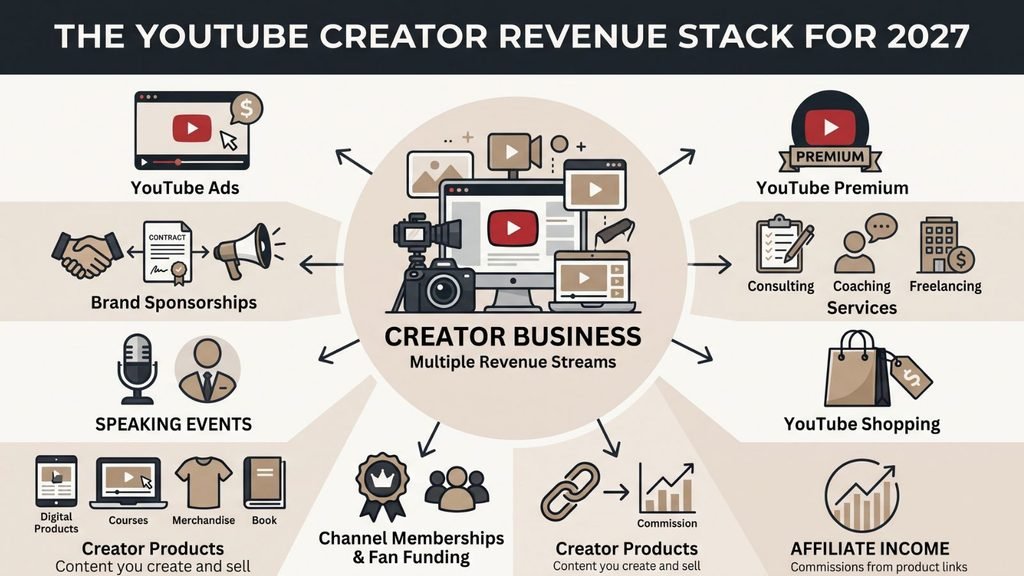
The biggest shift going into 2027 is diversification.
YouTube is building a platform where creators can earn through advertising, Premium, Shopping, brand partnerships, fan funding, and commerce. Meanwhile, the higher YPP ad-revenue threshold for new creators means relying on AdSense alone will become a weaker strategy. (support.google.com)
The most profitable creators will not just choose a profitable niche. They will build several revenue streams around a valuable audience.
Sources
Primary Sources
YouTube Help: Changes to the YouTube Partner Program
URL: YouTube Partner Program changes
Supported: February 1, 2027 YPP threshold changes, Shorts Creator Pool requirements, Premium Lite changes, and continued lower thresholds for Shopping, fan funding, and Creator Partnerships.
Publication date: Not listed
Accessed: August 27, 2026
YouTube Help: Understand Ad Revenue Analytics
URL: YouTube RPM and CPM definitions
Supported: Official definitions of RPM and CPM, factors that affect CPM, and revenue sources excluded from RPM.
Publication date: Not listed
Accessed: August 27, 2026
YouTube: From the CEO, What’s Coming to YouTube in 2026
URL: YouTube CEO 2026 letter
Supported: More than $100 billion paid to creators, YouTube Shopping participation, shopping strategy, brand partnerships, and YouTube’s creator-economy direction.
Publication date: January 21, 2026
Accessed: August 27, 2026
YouTube: Amazon Joins the YouTube Shopping Affiliate Program
URL: YouTube Shopping Amazon announcement
Supported: Amazon product tagging for eligible U.S. YouTube Shopping creators.
Publication date: August 27, 2026
Accessed: August 27, 2026
YouTube: Creator Partnerships
URL: YouTube Creator Partnerships announcement
Supported: YouTube’s growing infrastructure for connecting brands with creators.
Publication date: March 23, 2026
Accessed: August 27, 2026
Third-Party Sources
IAB: 2025 Creator Economy Ad Spend and Strategy Report
URL: IAB Creator Economy report
Supported: U.S. creator-economy advertising spending estimates for 2025 and 2026.
Publication date: November 20, 2025
Accessed: August 27, 2026
WordStream: Google Ads Benchmarks 2026
URL: WordStream 2026 Google Ads benchmarks
Supported: 2026 advertiser CPC and cost-per-lead benchmarks for legal, business, real estate, health, education, and home-improvement categories.
Publication date: 2026
Accessed: August 27, 2026
Gartner: Worldwide AI Spending Forecast
URL: Gartner AI spending forecast
Supported: AI software, services, cybersecurity, and infrastructure spending forecasts through 2027.
Publication date: May 19, 2026
Accessed: August 27, 2026
AIR Media-Tech: YouTube RPM by Niche in 2026
URL: AIR Media-Tech YouTube niche study
Supported: YouTube Analytics-based RPM data from 300 channels and evidence of large revenue variation within niches.
Publication date: July 1, 2026
Accessed: August 27, 2026
Nielsen: May 2026 Gauge Report
URL: Nielsen streaming and TV viewing report
Supported: YouTube’s 13.8 percent share of U.S. television watch time in May 2026.
Publication date: July 28, 2026
Accessed: August 27, 2026
EMARKETER: Influencer Marketing Spending Forecast
URL: EMARKETER 2027 influencer marketing forecast
Supported: Forecast that U.S. influencer-marketing spending will reach $13.7 billion by 2027.
Publication date: June 23, 2025
Accessed: August 27, 2026