

How Much Do YouTubers Make?
An in-depth study of YouTube earnings, RPMs, views, Shorts, sponsorships, memberships, and real creator income. Data current as of August 2026.
How much do YouTubers make?
For most creators, the most useful answer is not based on subscribers. It is based on views, RPM, audience location, content category, video format, and the other ways the creator monetizes the audience.
For long-form YouTube videos, a useful real-world benchmark is roughly $3 to $6 in revenue per 1,000 views, based on RPM figures shared by creators with Digiday. Some channels earn less. Channels in valuable advertising categories such as finance, business, software, and technology can earn substantially more.
At a $3 to $6 RPM, a monetized YouTuber could earn approximately:
| Monthly Long-Form Views | Estimated YouTube Revenue |
|---|---|
| 10,000 | $30 to $60 |
| 100,000 | $300 to $600 |
| 500,000 | $1,500 to $3,000 |
| 1 million | $3,000 to $6,000 |
| 5 million | $15,000 to $30,000 |
| 10 million | $30,000 to $60,000 |
These are estimates, not guaranteed payouts. A channel with a $10 RPM would make about $10,000 from 1 million views. A highly valuable finance video with a $20 RPM could generate about $20,000 from the same number of views.
YouTube Shorts are a different business. Shorts often earn only a few cents per 1,000 views, which means a million Shorts views can produce far less revenue than a million long-form views.
And advertising is only the beginning.
Successful YouTubers can also earn money from sponsorships, channel memberships, YouTube Premium, affiliate links, merchandise, products, courses, licensing, speaking, consulting, and entire companies built around their audiences.
That is why two YouTubers with the same subscriber count can have completely different incomes.
How YouTube Actually Pays Creators
YouTube does not have a fixed payment for every view.
Instead, creators in the YouTube Partner Program can receive a share of revenue generated through several monetization systems.
For standard long-form videos, YouTube currently pays creators 55% of net revenue from ads displayed or streamed on eligible public watch-page videos.
For Shorts, creators receive 45% of the revenue allocated to them from the Shorts Creator Pool.
For fan-funding products such as channel memberships, Super Chat, Super Stickers, and Super Thanks, YouTube says creators receive 70% of net revenue.
Creators can also receive revenue when YouTube Premium members watch their content. YouTube distributes a portion of Premium subscription revenue to creators based on viewing activity.
This system has become enormous.
YouTube reported in September 2025 that it had paid more than $100 billion to creators, artists, and media companies globally during the previous four years. There are now more than 3 million channels in the YouTube Partner Program.
Alphabet also reported that YouTube generated more than $60 billion in annual revenue from advertising and subscriptions in 2025.
The important point is that YouTube has become a major economic platform, but the money is not distributed evenly.
A small percentage of creators operate large businesses. Many monetized channels earn modest amounts. Others earn almost nothing because they receive few views or operate in categories with low advertising demand.
How Much Do YouTubers Make Per 1,000 Views?
The best metric for answering this question is RPM, or revenue per mille.
RPM tells creators approximately how much revenue they receive for every 1,000 views after YouTube’s revenue share.
YouTube says RPM can include revenue from:
- Advertising
- YouTube Premium
- Channel memberships
- Super Chat
- Super Stickers
For regular videos, RPM is calculated across all views, including views where an advertisement did not appear.
This is why RPM is more useful to creators than CPM.
CPM measures what advertisers pay. RPM measures what the creator actually receives per 1,000 views.
A creator might see an advertiser CPM of $15, for example, without earning $15 per 1,000 video views. YouTube takes its revenue share, some views have no advertisements, and several other factors affect the final amount.
A reasonable long-form YouTube RPM benchmark
In February 2025, Digiday interviewed six creators about Shorts and long-form monetization. Their average long-form RPMs were approximately $3 to $6.
That gives us a useful middle-of-the-road benchmark.
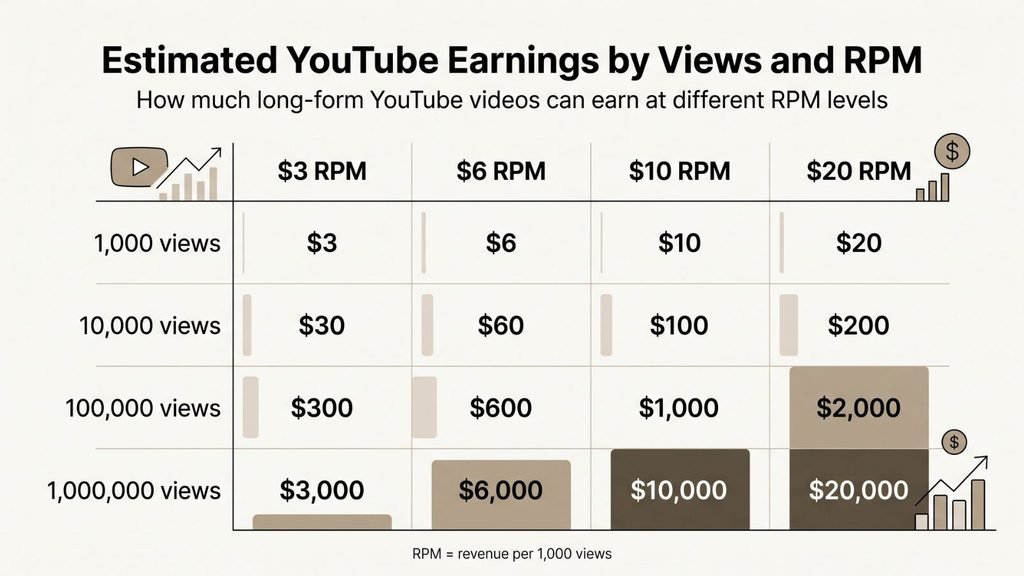
At those RPMs:
- 1,000 views: about $3 to $6
- 10,000 views: about $30 to $60
- 100,000 views: about $300 to $600
- 1 million views: about $3,000 to $6,000
- 10 million views: about $30,000 to $60,000
But there is no universal YouTube RPM.
Public creator disclosures show that some high-value videos can move far beyond this range.
Creator Anurthan Selvarajah, for example, reported an RPM of approximately $31 on a video about passive-income ideas. He said that single video generated about $18,000. His experience illustrates why financial and business content can have very different economics from general entertainment.
How Much Does YouTube Pay for 1 Million Views?
For a long-form video, 1 million views could reasonably produce a few thousand dollars in YouTube revenue, although the actual result can range much lower or higher.
Here is the math:
| RPM | Revenue From 1 Million Views |
| $1 RPM | $1,000 |
| $3 RPM | $3,000 |
| $5 RPM | $5,000 |
| $6 RPM | $6,000 |
| $10 RPM | $10,000 |
| $20 RPM | $20,000 |
| $30 RPM | $30,000 |
A broad entertainment video watched mainly in lower-value advertising markets might fall toward the bottom.
A business, investing, software, or technology video reaching adults in markets such as the United States could be worth much more to advertisers.
The same million views can therefore generate dramatically different amounts of money.
Why 1 million views do not always pay the same
YouTube identifies several reasons advertising rates change.
They include:
- Viewer location: Advertisers pay different prices to reach consumers in different countries.
- Time of year: Advertising demand often rises around major shopping periods and holidays.
- Advertising format: Different types of advertisements have different prices.
- Advertiser demand: Some subjects attract more competition from advertisers.
- Monetized playbacks: Not every viewer is shown an advertisement.
- Advertiser-friendly status: Videos with limited advertising eligibility can earn much less.
Video length can matter too. Longer eligible videos can offer more opportunities for advertisements, including mid-roll ads.
This is why a creator should never assume that one viral video’s RPM will apply to every future upload.
How Much Do YouTubers Make Per View?
YouTube does not technically pay a fixed amount for each individual view.
However, RPM lets us translate average earnings into an approximate revenue per view.
At a $3 RPM:
$3 ÷ 1,000 = $0.003 per view
At a $6 RPM:
$6 ÷ 1,000 = $0.006 per view
At a $10 RPM:
$10 ÷ 1,000 = $0.01 per view
So a long-form YouTuber might effectively earn somewhere around a fraction of a cent to several cents per view, depending on the channel.
This should only be used as an average.
One individual view might generate no advertising revenue. Another viewer might watch a video with multiple advertisements. A Premium subscriber can generate subscription revenue without seeing an advertisement at all.
How Much Do YouTube Shorts Pay?
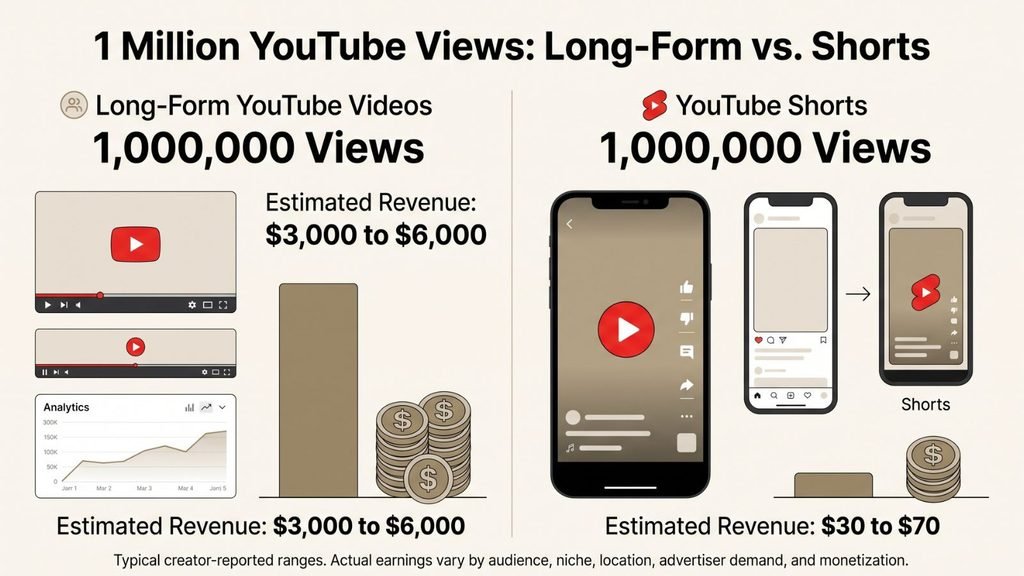
YouTube Shorts can generate extraordinary reach, but they generally pay much less per view than long-form YouTube videos.
Digiday’s 2025 reporting found that six creators had Shorts RPMs consistently below $0.20, while their long-form videos earned approximately $3 to $6 per 1,000 views.
Shopify’s 2026 review of creator reports placed typical Shorts RPMs at roughly $0.03 to $0.07 per 1,000 engaged views.
Using that range:
- 100,000 Shorts views: about $3 to $7
- 1 million Shorts views: about $30 to $70
- 10 million Shorts views: about $300 to $700
- 100 million Shorts views: about $3,000 to $7,000
Some creators do better.
Linus Media Group provided one useful real-world example. According to Forbes, one of the company’s Shorts received approximately 13 million views and earned about $1,300.
That works out to an RPM of approximately $0.10.
At that rate, a million Shorts views would produce about $100.
Why Shorts pay less
Long-form ads can appear before, during, and after individual videos.
Shorts advertising works differently. Advertisements appear between videos in the Shorts Feed. Revenue is pooled and then allocated among eligible creators based on their share of engaged Shorts views before the creator receives the applicable 45% revenue share.
This creates a very different revenue structure.
For many creators, Shorts are therefore more valuable as an audience-growth and discovery tool than as the primary source of advertising income.
A creator who can turn Shorts viewers into long-form viewers, customers, members, or buyers may create far more value than the Shorts advertising payment itself.
How Much Do YouTubers Make From Sponsorships?
For established creators, sponsorships can be worth considerably more than YouTube advertising.
The opportunity is expanding quickly.
The Interactive Advertising Bureau estimated that U.S. creator advertising spending reached $37 billion in 2025 and projected it to reach $44 billion in 2026.
YouTube is especially valuable to sponsors because a creator can spend 30, 60, or 90 seconds explaining a product inside content an audience intentionally chose to watch.
Real creator sponsorship asking prices
Creator marketplace 1stCollab analyzed 100,000 creators’ initial asking prices during 2025.
Across platforms and formats, it found the following median asking prices by audience size:
- Under 10,000 followers or subscribers: $300
- 10,000 to 25,000: $350
- 25,000 to 100,000: $750
- 100,000 to 250,000: $1,500
- 250,000 to 500,000: $2,500
- 500,000 to 1 million: $3,999
- 1 million or more: $7,000
Those were asking prices, not necessarily the final negotiated payments. The analysis also found that YouTube was usually the most expensive platform, with dedicated YouTube videos among the costliest formats.
SponsorRadar, which tracks sponsorship activity across tens of thousands of YouTube channels, reports that sponsorship CPMs can range from around $10 to $80 per 1,000 expected views, depending heavily on the category. Finance and business audiences sit near the high end, while gaming and entertainment tend to command lower rates.
That means a creator averaging 100,000 views per video could potentially sell a sponsorship for:
- $1,500 at a $15 sponsorship CPM
- $2,500 at a $25 sponsorship CPM
- $4,000 at a $40 sponsorship CPM
- $8,000 at an $80 sponsorship CPM
This is one reason a relatively small YouTuber with the right audience can build a serious business.
A finance channel reaching 75,000 investors or business owners may be more commercially valuable than an entertainment channel reaching several times as many casual viewers.
YouTube Premium Can Be More Important Than It Looks
YouTube Premium is often overlooked when people estimate creator earnings.
Premium subscribers do not see normal YouTube advertisements, but creators can still earn money when those subscribers watch their videos.
YouTube says membership revenue is distributed to creators based on how much Premium members watch their content.
Linus Media Group offers a striking example.
Forbes reported that 61.5% of the company’s YouTube revenue in 2024 came from traditional advertising, while 37.3% came from YouTube Premium, even though Premium users accounted for only 29% of views.
That does not mean every channel will see the same percentage.
It does show that simply multiplying views by an advertising CPM can miss a meaningful part of a creator’s YouTube income.
How Much Do YouTubers Make From Memberships and Fans?
YouTube also lets creators earn directly from their most loyal viewers through:
- Channel memberships
- Super Chat
- Super Stickers
- Super Thanks
YouTube’s standard Commerce Product Module pays creators 70% of net revenue from these features.
For a channel with a passionate audience, fan funding can become substantial.
Imagine 500 members effectively generating an average of $5 each in monthly membership revenue before applicable deductions and platform sharing. That audience represents $2,500 in monthly gross membership spending.
A large live-streaming creator may also receive significant Super Chat and Super Sticker purchases during broadcasts.
The important metric is not only audience size. It is audience intensity.
A channel with 50,000 deeply involved fans can sometimes monetize more effectively than a channel with 500,000 passive subscribers.
How Many Subscribers Do You Need to Make Money on YouTube?
YouTube currently has two important monetization levels in eligible markets.
Creators can access the expanded YouTube Partner Program with:
- 500 subscribers
- At least 3 valid public uploads in the previous 90 days
- Either 3,000 qualified public watch hours in the previous 12 months or 3 million qualified Shorts views in the previous 90 days
This level can unlock features such as fan funding and certain Shopping opportunities.
For advertising revenue sharing and YouTube Premium revenue, creators generally need:
- 1,000 subscribers
- Either 4,000 qualified public watch hours during the previous 12 months or 10 million qualified Shorts views during the previous 90 days
YouTube has announced additional Partner Program changes scheduled to take effect on February 1, 2027, so creators reading this after that date should verify the latest requirements directly with YouTube.
Does YouTube pay for subscribers?
No. YouTube does not pay creators simply for having subscribers.
Subscribers matter because they can create repeat viewers.
But a dormant channel with 1 million subscribers and few current views may earn less than an active 100,000-subscriber channel generating hundreds of thousands of views every month.
For revenue analysis, monthly views and RPM are more useful than subscriber count.
Real Examples of How Much YouTubers Make
Public disclosures and industry estimates show just how wide the income range can be.
Linus Media Group
Linus Media Group reported that its main Linus Tech Tips channel and related properties have built a substantial YouTube business.
The company disclosed a revenue mix where traditional YouTube advertising represented 61.5% of YouTube revenue and YouTube Premium represented 37.3% during the period Forbes examined.
Separately, Linus Sebastian revealed that the main business had generated roughly $26 million in lifetime Google AdSense revenue.
The company also earns through sponsorships, merchandise, products, and other operations, making YouTube advertising only one part of the business.
A high-RPM business creator
Anurthan Selvarajah publicly reported a $31 RPM on a passive-income video that generated about $18,000.
That is more than five times the top of the $3 to $6 long-form RPM range reported by the Digiday creators.
It demonstrates the financial value of an advertiser-friendly audience interested in money, business, and software products.
Alex Costa
Men’s fashion and grooming creator Alex Costa shows what can happen when the audience becomes the distribution engine for a separate company.
Costa told Business Insider that he landed a six-figure Old Spice brand deal after becoming a full-time creator. He later built men’s hair-care company Forte Series, which was on track for approximately $10 million in 2025 revenue.
That is business revenue rather than YouTube pay, but the distinction is important.
For advanced creators, the largest financial opportunity may not be getting YouTube to pay more for views. It may be using YouTube to build demand for something the creator owns.
How Much Do the Biggest YouTubers Make?
The highest-paid creators operate at a completely different scale.
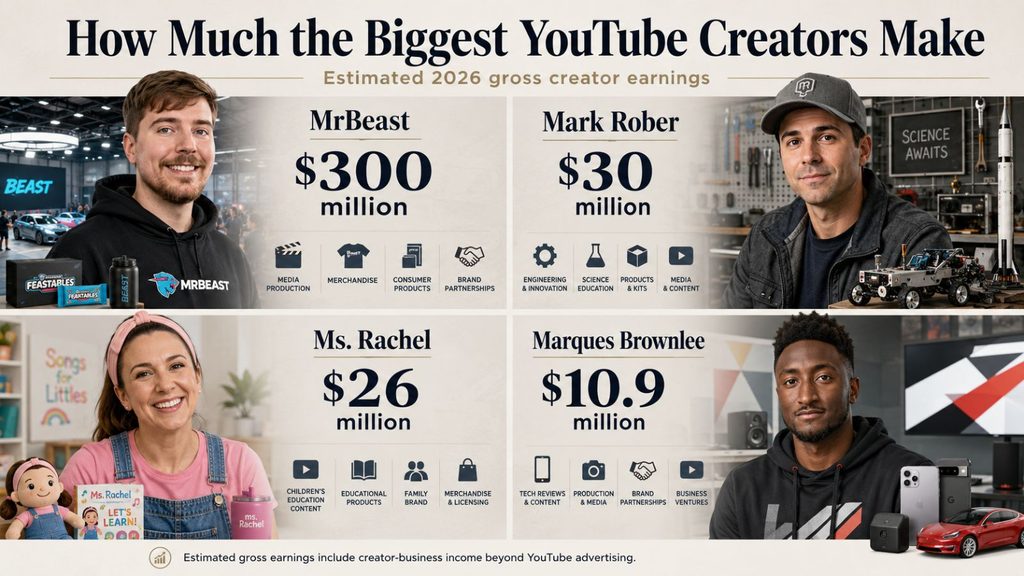
Forbes’ 2026 Top Creators ranking estimated gross earnings between March 2025 and March 2026. Its figures include creator-business earnings across platforms and businesses, not just YouTube AdSense.
Among prominent YouTube-focused creators, Forbes estimated:
- MrBeast: $300 million
- Dhar Mann: $65 million
- Mark Rober: $30 million
- Ms. Rachel: $26 million
- Marques Brownlee: $10.9 million
- Typical Gamer: $13 million
- Alan Chikin Chow: $10.5 million
- iJustine: $3.4 million
- Steven He: $2 million
These should not be interpreted as personal salaries or YouTube ad payments.
Forbes measures estimated gross earnings. Many major creators operate companies with employees, studios, equipment, production budgets, managers, professional services, product costs, and other expenses.
MrBeast is a particularly extreme example. His creator operation now includes entertainment, consumer products, software, licensing, and other businesses.
What Determines How Much a YouTuber Makes?
After examining the data, seven variables explain most of the difference between a low-earning channel and a high-earning one.
1. Monthly views
Views create the economic opportunity. Subscriber count alone does not.
2. Long-form versus Shorts
Long-form videos generally generate much more revenue per 1,000 views than Shorts.
3. Audience location
An audience concentrated in countries with strong advertiser demand may command higher CPMs.
4. Content niche
Finance, technology, business, software, education, and other commercially valuable subjects can attract more advertiser competition than broad entertainment.
5. Video length and monetization opportunities
Longer eligible content can provide more opportunities for ads, including mid-roll placements.
6. Audience trust
Strong creator-audience relationships make sponsorships, affiliate offers, memberships, and products more valuable.
7. Revenue diversification
The biggest creator businesses rarely depend on AdSense alone.
Advertising can provide dependable baseline income, but sponsorships and owned products can dramatically increase the revenue generated from the same audience.
The Most Important Lesson About YouTube Earnings
The central lesson from this research is simple:
Views create attention, but the business model determines what that attention is worth.
A million long-form views at a $3 RPM might produce around $3,000.
A million views at a $10 RPM might produce $10,000.
A million Shorts views might produce less than $100 for some creators.
Meanwhile, a creator averaging only 100,000 views per video could potentially earn thousands of dollars from a single well-matched sponsor.
Another creator might use the same audience to sell software, courses, products, consulting, memberships, or merchandise and make even more.
This is why asking, “How many subscribers do I need to make $100,000 on YouTube?” is usually the wrong question.
A better question is:
How many valuable views can I consistently generate, and how many effective ways do I have to monetize the people watching?
The creators who build durable businesses tend to solve both sides of that equation.
Frequently Asked Questions About YouTube Earnings
How much do YouTubers make per 1,000 views?
For long-form content, $3 to $6 per 1,000 views is a useful working benchmark based on creator RPMs reported by Digiday, although actual earnings can be much lower or much higher. High-value business or finance channels can sometimes see RPMs above $10 or $20.
How much money is 100,000 YouTube views?
At a $3 to $6 RPM, 100,000 long-form views would generate approximately $300 to $600 in YouTube revenue.
At a $10 RPM, the same 100,000 views would generate approximately $1,000.
How much money is 1 million YouTube views?
Using a $3 to $6 long-form RPM, 1 million views would generate roughly $3,000 to $6,000.
Channels with higher RPMs can earn $10,000, $20,000, or more from the same number of views.
How much does 1 million YouTube Shorts views pay?
Creator reports commonly place Shorts RPM far below long-form RPM. A typical range of roughly $0.03 to $0.07 RPM would translate to approximately $30 to $70 for 1 million engaged Shorts views. Results vary significantly.
How much do YouTubers with 100,000 subscribers make?
There is no standard income for a 100,000-subscriber channel.
If the creator generates 500,000 long-form views a month at a $3 to $6 RPM, YouTube revenue might be around $1,500 to $3,000 per month before considering sponsorships and outside revenue.
A creator with valuable sponsorships could earn several thousand dollars more from each sponsored video.
How much do YouTubers with 1 million subscribers make?
Again, subscribers do not determine earnings.
A 1 million-subscriber creator generating several million monthly views could potentially earn tens of thousands of dollars per month from YouTube, plus sponsorship income.
1stCollab’s 2025 data found creators with at least 1 million followers or subscribers had a median initial sponsorship asking price of $7,000 per post across the campaigns it analyzed.
Can a small YouTuber make a full-time income?
Yes, but it usually requires more than reaching the minimum monetization threshold.
A smaller creator can build meaningful income by combining long-form views with sponsorships, affiliate marketing, memberships, services, or products.
A focused channel with a commercially valuable audience may need far fewer viewers than a broad entertainment channel to build the same business.
Is YouTube still worth starting?
The platform continues to support one of the largest creator economies in the world.
YouTube has paid more than $100 billion to creators, artists, and media companies over four years, while U.S. creator advertising spending across the broader creator economy reached $37 billion in 2025.
The opportunity is real, but making money on YouTube is not automatic. The creators who succeed treat audience growth and monetization as two different problems that must both be solved.
Sources
Primary Sources
YouTube Help: Partner Earnings Overview
URL: YouTube partner earnings overview
Supported: Watch-page advertising revenue share, Shorts revenue share, fan-funding revenue share, monetization methods.
Publication date: Not listed.
Access date: August 26, 2026.
YouTube Help: Expanded YouTube Partner Program
URL: YouTube Partner Program eligibility
Supported: Current 500-subscriber and full advertising monetization eligibility requirements.
Publication date: Not listed.
Access date: August 26, 2026.
YouTube Help: Understanding RPM and CPM
URL: YouTube revenue analytics guide
Supported: Official RPM and CPM definitions, factors affecting advertising revenue, monetized playbacks.
Publication date: Not listed.
Access date: August 26, 2026.
YouTube Help: Shorts Monetization Policies
URL: YouTube Shorts monetization policies
Supported: Shorts Creator Pool mechanics and revenue sharing.
Publication date: Not listed.
Access date: August 26, 2026.
YouTube Blog: Made on YouTube 2025
URL: Made on YouTube 2025 creator economy announcement
Supported: More than $100 billion paid to creators, artists, and media companies over four years.
Publication date: September 16, 2025.
Access date: August 26, 2026.
Alphabet Investor Relations: 2025 Q4 Earnings Call
URL: Alphabet 2025 Q4 earnings call
Supported: YouTube surpassed $60 billion in annual advertising and subscription revenue in 2025.
Publication date: February 4, 2026.
Access date: August 26, 2026.
Third-Party Sources
Digiday: YouTube Shorts Revenue vs. Long-Form Revenue
URL: Digiday creator RPM analysis
Supported: Six creators reporting Shorts RPM below $0.20 and long-form RPM around $3 to $6.
Publication date: February 25, 2025.
Access date: August 26, 2026.
IAB: 2025 Creator Economy Ad Spend & Strategy Report
URL: IAB Creator Economy report
Supported: $37 billion in U.S. creator advertising spending in 2025 and $44 billion projection for 2026.
Publication date: November 20, 2025.
Access date: August 26, 2026.
1stCollab: Creator Partnership Pricing Study
URL: 1stCollab creator pricing study
Supported: Initial sponsorship asking prices from a 100,000-creator dataset and comparisons by audience size and platform.
Publication date: October 17, 2025.
Access date: August 26, 2026.
Forbes: Top Creators 2026
URL: Forbes Top Creators 2026
Supported: Estimated gross earnings for MrBeast, Dhar Mann, Mark Rober, Ms. Rachel, Marques Brownlee, and other major creators.
Publication date: June 23, 2026. Updated August 6, 2026.
Access date: August 26, 2026.
Forbes: Linus Media Group Revenue Breakdown
URL: Forbes Linus Media Group analysis
Supported: Linus Media Group’s YouTube advertising, Premium, sponsorship, and Shorts revenue mix.
Publication date: March 29, 2025.
Access date: August 26, 2026.
Business Insider: Alex Costa Creator Business
URL: Business Insider Alex Costa profile
Supported: Six-figure sponsorship example and growth of creator-founded Forte Series.
Publication date: May 1, 2025.
Access date: August 26, 2026.