

How to Make Money on Facebook in 2026 and 2027: 8 Proven Ways
If you want to learn how to make money on Facebook, the first thing to understand is that there is no single Facebook paycheck.
Facebook can pay creators directly for eligible content. Fans can support creators through Stars and Subscriptions. Brands can pay for sponsored content. Businesses can use Facebook to sell products and services. Marketplace can even become a side hustle of its own.
That mix matters because the strongest Facebook businesses do not depend on one revenue source.
Facebook’s creator economy has also changed quickly. In 2024, Meta began combining several older programs, including In-stream Ads, Ads on Reels, and the Performance Bonus, into a unified program called Facebook Content Monetization. By March 2026, Meta said the program could pay eligible creators across short and long videos, Stories, photos, and text posts. Meta also said Facebook paid creators nearly $3 billion in 2025, up 35% from the previous year. About 60% of those payouts went to Reels.
That does not mean earning money on Facebook is automatic. Access varies by account, country, feature, policy status, and the quality of your content. It does mean Facebook has become a serious monetization platform again.
Here are the strongest ways to turn Facebook attention into income in 2026.
1. Earn Through Facebook Content Monetization
For creators, Facebook Content Monetization is the most important native earning program to understand.
Meta created it to simplify several older monetization systems. Instead of treating Reels, longer videos, photos, and text as separate earning programs, eligible creators can earn from multiple formats under one program.
Meta says earnings are performance-based. In 2026, it introduced three metrics to help creators understand those payouts:
- Qualified Views: views that may be eligible to generate earnings
- Earnings Rate: approximate earnings per 1,000 qualified views
- Non-Qualified Views: views that do not count toward earnings, along with reasons they were excluded
This is an important shift. It means raw view count is not the whole story. Meta says it is placing more emphasis on original content, deeper engagement, longer watch time, and qualified views.
How to Get Facebook Content Monetization
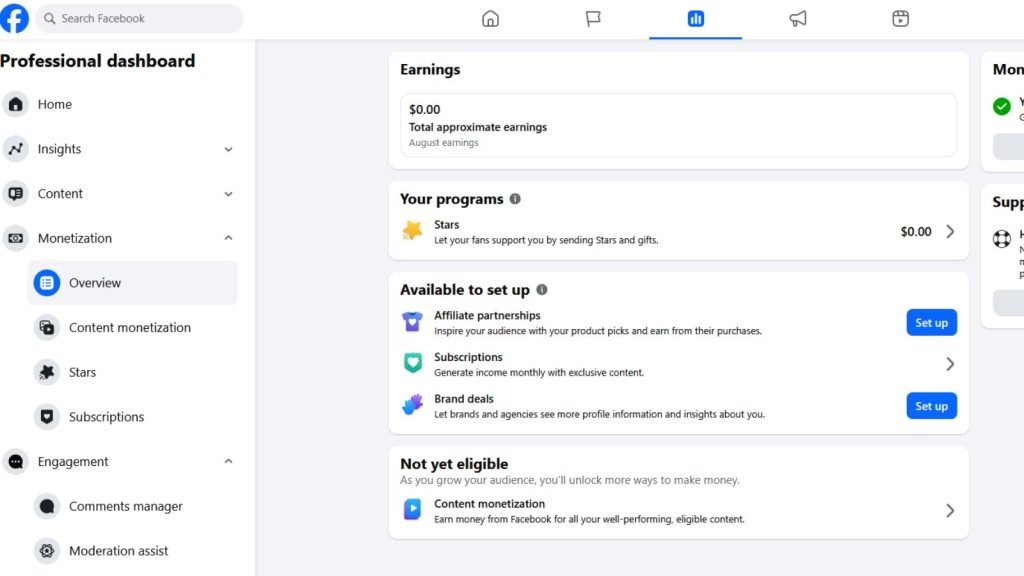
As of Meta’s March 2026 update, Facebook Content Monetization remained invite-only. Creators who do not have access can express interest through the Facebook mobile app:
Professional Dashboard > Monetization > Content Monetization
From there, eligible accounts may see an interest form.
This is why you should be careful with articles or videos that promise a guaranteed invitation once you hit a specific follower number. Meta’s current public announcement does not give one universal follower or watch-time threshold that guarantees entry into Content Monetization. Your Professional Dashboard is the best place to see your account’s actual status.
You will generally need a Facebook Page or a profile using professional mode, a supported account and location, a payout setup, and compliance with Meta’s monetization policies.
What Content Can Earn Money?
Meta says eligible public content can include:
- Reels and other video
- Stories
- Photo posts
- Text posts
Facebook also began shifting all newly uploaded videos into the Reels publishing system. Meta announced that Reels would no longer be limited by length or orientation after the change reached an account, which makes the distinction between a “video post” and a “Reel” much less important than it used to be.
The practical lesson is simple: do not build a Facebook strategy around one format. Test short videos, longer videos, photos, Stories, and text. A creator who can earn from several formats has more opportunities than a creator waiting for every Reel to go viral.
2. Make Money With Facebook Stars
Facebook Stars are one of the clearest examples of fan-funded monetization.
Viewers buy Stars from Meta and send them to eligible creators as a form of support. Stars can appear on eligible content such as live streams, videos, Reels, and other supported posts.
Meta has stated that an eligible creator earns $0.01 for each Star received. That means 100 Stars equals $1 in creator earnings, while 10,000 Stars equals $100.
Stars work best when the audience feels involved. A creator who simply turns Stars on and never mentions them may earn very little. A creator who builds participation into the experience can make them more meaningful.
For example, a creator could:
- Thank people who send Stars during a Live
- Set a visible Stars goal
- Use Live streams for Q&A sessions
- Celebrate top supporters
- Create recurring shows that give fans a reason to come back
The value of Stars is not only the one-cent payout. It is that they turn a passive audience into a group of supporters.
For creators with a smaller but loyal following, that can be more valuable than chasing millions of low-intent views.
3. Build Recurring Revenue With Facebook Subscriptions
Advertising revenue can change from month to month. Subscriptions can make creator income more predictable.
Facebook Subscriptions allow eligible creators to offer paid monthly support in exchange for benefits such as exclusive content, closer interaction, subscriber-only posts, or badges. Meta’s own creator training describes Subscriptions as a way to monetize content and connect directly with fans.
The business model is straightforward.
If 100 people pay $5 per month, that is $500 in gross monthly subscription revenue before any applicable platform, app-store, payment, tax, or other costs. If 500 people pay $5, that becomes $2,500.
The hard part is not turning the feature on. The hard part is giving people a reason to stay subscribed.
Good subscriber offers usually provide one or more of these:
- Access, such as subscriber-only Lives
- Education, such as tutorials or workshops
- Community, such as private conversations or groups
- Recognition, such as badges or shout-outs
- Convenience, such as templates, recaps, or curated resources
Do not make the paid tier feel like a punishment for free followers. Your public content should still be useful. The subscription should offer a deeper layer for the people who want more.
Feature availability and eligibility can vary, so check the Monetization section of your Professional Dashboard rather than relying on an old follower threshold you find online.
4. Get Paid by Brands for Sponsored Content
You do not need Facebook to pay you directly to make money from your Facebook audience.
For many creators, brand deals can be worth more than platform payouts.
A company may pay you to create a Reel, photo post, video, Live segment, testimonial, tutorial, or campaign that features its product. The price depends on more than follower count. Brands also care about audience fit, engagement, content quality, usage rights, conversion potential, and whether they can reuse or promote the content.
Meta supports brand collaborations through branded content and partnership ads. In late 2025, Meta expanded Facebook partnership-ad options to include more creators using professional mode, not just Pages. Partnership ads allow advertisers to amplify creator content with the creator’s identity attached.
That creates two possible revenue layers:
- The brand pays you to create and publish the content.
- The brand may pay additional money for advertising rights, usage rights, exclusivity, or extended campaign use.
Do not give those rights away automatically. A brand asking to run your face and content in paid ads for six months is asking for more than a normal sponsored post.
Also disclose paid relationships clearly. In the United States, the FTC says creators should make material connections to brands obvious, including payments, free products, discounts, or other things of value. The disclosure should be easy to notice and placed with the endorsement itself.
5. Use Affiliate Marketing on Facebook
Affiliate marketing lets you earn a commission when someone buys through your tracked link or code.
This works especially well for creators whose content naturally leads to product recommendations. Examples include:
- Beauty tutorials
- Home improvement
- Cooking
- Tech reviews
- Fitness gear
- Books
- Parenting products
- Travel equipment
- Business software
- Creator tools
The mistake is turning every post into a sales pitch.
A stronger approach is to make the content useful first. Show the product solving a real problem. Compare it with alternatives. Explain who it is for and who should skip it. Then give people a simple path to buy if they want it.
Affiliate income can also stack with other Facebook monetization. A useful Reel could potentially earn through Facebook Content Monetization, generate Stars, attract a sponsor, and send viewers to an affiliate offer.
That is why creators should think in terms of revenue per piece of content, not just revenue per view.
If you earn a commission, disclose it clearly. The FTC specifically says affiliate relationships should be disclosed clearly and conspicuously, close to the recommendation or link.
6. Sell Your Own Products, Services, or Digital Offers
For many creators and small businesses, the highest-value use of Facebook is not getting paid by Facebook. It is using Facebook to attract customers to something you own.
That could be:
- Coaching
- Consulting
- Freelance services
- Online courses
- Paid communities
- Digital downloads
- Templates
- Books
- Merchandise
- Local services
- Physical products
- Events
- Memberships
The advantage is control.
Platform payouts can change. A customer relationship, email list, membership, or product business is something you can build beyond one social network.
Imagine a creator who teaches home organization. A viral Facebook Reel may create attention, but the larger business could include a $19 checklist, a $79 video course, affiliate links to storage products, and a consulting service.
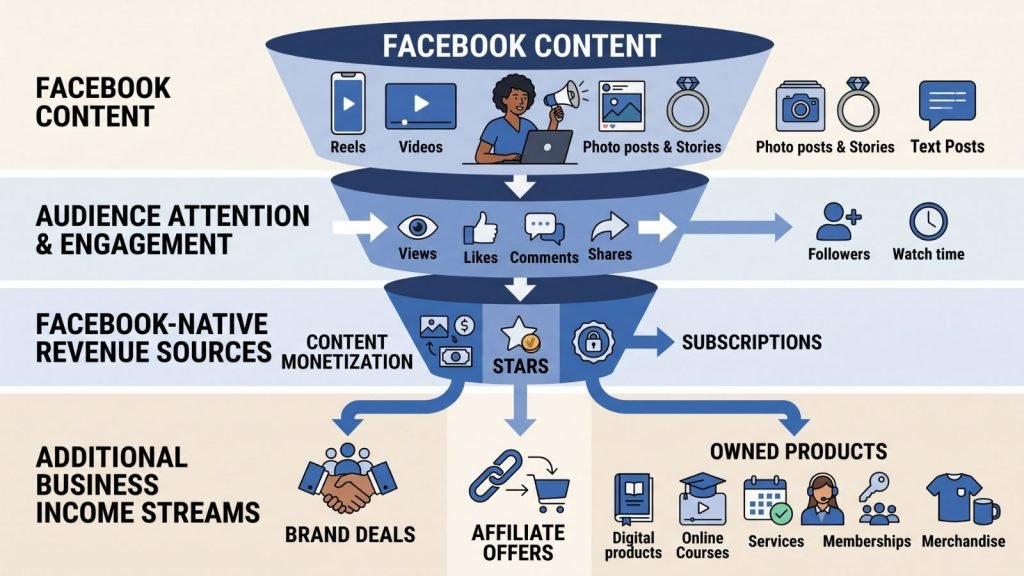
The Reel is not the business. The Reel is the top of the funnel.
A simple Facebook sales funnel can look like this:
- Publish content that solves a specific problem.
- Invite interested viewers to a useful free resource, product page, booking page, or email list.
- Build trust through follow-up content.
- Offer a relevant paid product or service.
- Use customer questions to create the next round of content.
This method can work even if your account has not been invited into Facebook Content Monetization.
7. Sell Items Through Facebook Marketplace
Facebook Marketplace is still one of the largest ways to make money on Facebook without becoming a traditional content creator.
Meta says people can sell through Marketplace, buy-and-sell groups, Pages, and, where available, shipping-enabled listings.
Marketplace is especially useful for:
- Selling unused household items
- Flipping furniture
- Reselling vintage goods
- Selling electronics
- Moving inventory locally
- Running a niche resale side hustle
- Testing demand before building a larger ecommerce operation
Facebook has been investing in Marketplace again. In July 2026, Meta said 430 million items and 44 million vehicles are listed on Marketplace globally each month. It also launched a separate Seller app for U.S. users age 18 and older, with listing creation, inventory management, a unified inbox, and performance insights.
That makes Marketplace more than a place to sell an old couch. For some people, it can become a repeatable small business.
The basic formula is familiar: source items below market value, create clear listings, take good photos, respond quickly, price intelligently, and protect your margin.
Do not confuse Marketplace revenue with creator monetization. They are different systems, but both answer the same question: how can Facebook help you make money?
8. Use Facebook to Grow a Paid Community or Membership
Facebook Groups can be extremely valuable even when the payment happens somewhere else.
A creator can use public content to attract people around a shared interest, then move the most engaged members into a paid membership, coaching program, course community, or subscription product.
The Facebook Group becomes the relationship layer.
For example, a fitness creator might publish free workout clips on a professional profile, run a free Facebook Group for accountability, and then sell a monthly coaching membership. A business educator might use a Group for weekly discussions and direct members to workshops or consulting.
This approach works because people often pay for more than information. They pay for:
- Accountability
- Feedback
- Access
- Belonging
- Structure
- Networking
- A faster path to a result
If you build a paid community around Facebook, make sure members understand exactly what they are paying for and where billing happens. Do not make access depend on vague promises.
The strongest community businesses also collect email addresses and maintain a relationship with members outside Facebook. That reduces the risk of building the entire business on rented platform access.
Creator Fast Track Can Pay Established Creators to Start on Facebook
If you already have a large following on another platform, Facebook may have a shortcut.
In March 2026, Meta launched Creator Fast Track, a program designed for established creators who are new to Facebook or returning to it.
Meta said eligible participants can receive increased reach on qualifying Reels, three months of guaranteed pay, and immediate access to Facebook Content Monetization. The company publicly listed $1,000 per month for creators with at least 100,000 followers on Instagram, TikTok, or YouTube, and $3,000 per month for creators with more than one million followers on at least one of those platforms.
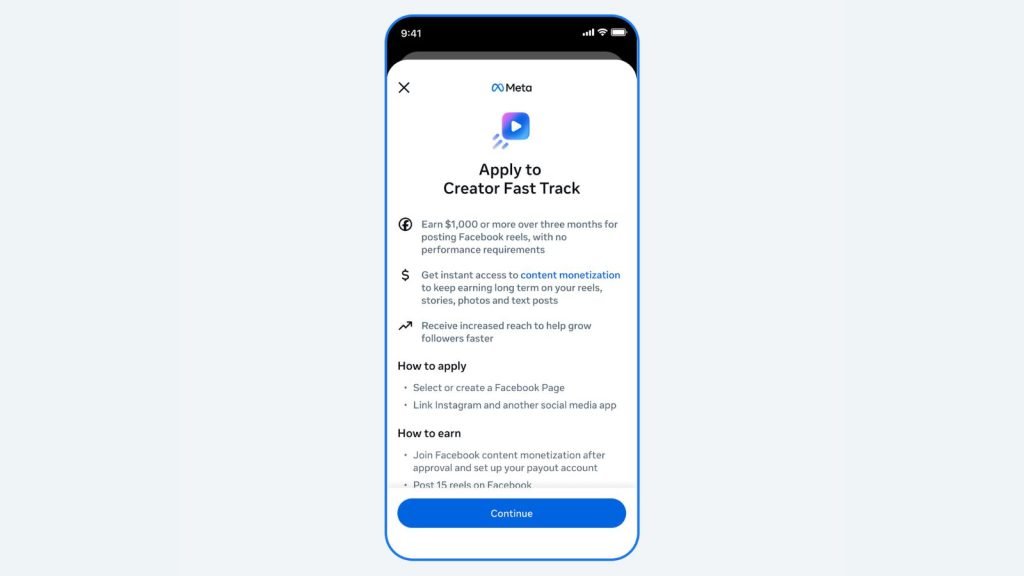
This is not relevant to every creator, but it shows how aggressively Meta is competing for established talent.
If you already have an audience elsewhere, do not assume you need to rebuild from zero before Facebook can become a revenue channel. Check the current Creator Fast Track terms and your Professional Dashboard to see whether you qualify.
How Much Money Can You Make on Facebook?
There is no honest universal answer.
Facebook does not publish one fixed payment per 1,000 views for Content Monetization. Earnings vary based on qualified views, performance, engagement, watch behavior, content eligibility, audience, and other factors Meta uses in its payout system. Meta’s newer dashboard even includes an Earnings Rate metric that shows an approximate amount per 1,000 qualified views for the individual creator.
This is why claims such as “Facebook pays exactly $5 per 1,000 views” should be treated with caution.
A creator’s income can come from several places at once:
- Content Monetization payouts
- Stars
- Subscriptions
- Sponsorships
- Affiliate commissions
- Product sales
- Services
- Marketplace sales
- Membership revenue
One creator with 50,000 followers may earn less than another creator with 10,000 followers if the smaller audience buys more, sends more Stars, subscribes, or attracts better sponsors.
The better question is not, “How much does Facebook pay?”
It is, “How much revenue can I build from the attention I create on Facebook?”
What Facebook Rewards in 2026
If you want to make money on Facebook for the long term, your content strategy has to match what the platform is rewarding.
Original Content Matters More
Meta has become much more aggressive about deprioritizing unoriginal content.
In March 2026, Meta said content filmed or produced directly by the creator or Page owner is considered original. It also said third-party clips can still qualify as original when a creator adds genuinely new information, analysis, or substantial creative value.
However, simple reaction faces, stitched clips, basic narration of what is already happening, minor speed changes, borders, or captions added to someone else’s work may be treated as unoriginal. Accounts that repeatedly post low-value reused content can lose recommendation reach and may be demonetized.
This is one of the most important monetization lessons on Facebook today.
Do not build your business on copied viral clips.
Avoid Spam Tactics
Meta has also targeted accounts that try to game distribution.
In 2025, Facebook said accounts using long distracting captions, excessive hashtags, unrelated captions, spam networks, or coordinated fake engagement could lose reach and monetization eligibility.
That means the old growth-hack mentality can backfire.
Use a caption because it helps the post. Use hashtags because they are relevant. Ask for comments when there is a real reason for discussion. Do not stuff a post with unrelated text just to chase reach.
Focus on Qualified Attention
A million weak views are not automatically better than 100,000 strong views.
Meta’s 2026 monetization metrics make that clear. Qualified views, deeper engagement, and longer watch time matter.
Create content that makes people:
- Stop scrolling
- Watch longer
- Finish the video
- Share it
- Comment with real thoughts
- Follow for more
- Return later
- Take a useful next step
That is the kind of attention that can support both platform payouts and an independent creator business.
A Practical Facebook Monetization Strategy
Trying all eight revenue methods at once is usually a mistake.
Start with a simple system.
Step 1: Choose One Audience
Be clear about who your content is for and what they care about.
“People who like food” is too broad.
“Busy parents who want 20-minute dinners” is much more useful.
Step 2: Build Around Two or Three Repeatable Content Formats
For example:
- Short educational Reels
- One longer weekly video or Live
- Photo or text posts that start conversations
Because Facebook Content Monetization can cover multiple formats, you do not have to force every idea into a 30-second clip.
Step 3: Turn on Every Monetization Tool You Are Eligible For
Check Professional Dashboard > Monetization regularly.
If Stars are available, set them up.
If Subscriptions are available, decide what the paid tier will offer.
If Content Monetization shows an invitation or interest form, complete it.
Step 4: Add One Revenue Stream You Control
This could be an affiliate offer, service, course, product, newsletter, or membership.
The goal is to avoid being completely dependent on Meta payouts.
Step 5: Review Revenue, Not Just Reach
Track:
- Qualified views
- Earnings rate
- Followers gained
- Watch time
- Shares
- Stars received
- Subscribers
- Affiliate clicks
- Leads
- Sales
- Revenue by content type
A post with 50,000 views and $500 in sales can be more valuable than a post with one million views and no business result.
Common Mistakes That Stop Creators From Making Money on Facebook
The most common mistake is waiting for monetization before treating Facebook like a business.
You can start building an audience, collecting customer insights, selling services, using affiliate offers, and developing products before Meta ever invites you into Content Monetization.
Other mistakes include:
- Reposting other people’s clips with minimal changes
- Buying followers, views, or fake engagement
- Publishing unrelated captions or excessive hashtags
- Depending on one viral content format
- Ignoring email lists and owned customer relationships
- Accepting brand deals without pricing usage rights
- Promoting affiliate links without clear disclosure
- Creating a subscription with no reason to stay subscribed
- Measuring success only by follower count
Facebook can provide reach. It can provide monetization tools. It can even provide guaranteed payments to some established creators.
But you still need a business model.
Frequently Asked Questions About Making Money on Facebook
Can You Really Make Money on Facebook?
Yes. Creators can earn through Facebook Content Monetization, Stars, Subscriptions, sponsorships, affiliate marketing, product and service sales, Marketplace, and paid communities or memberships. Some methods are paid directly by Meta, while others use Facebook to reach customers or sponsors.
How Many Followers Do You Need to Make Money on Facebook?
There is no single follower number that unlocks every way to earn. Different features have different eligibility rules, and Facebook Content Monetization was still invite-only in Meta’s March 2026 update. You can also earn through brand deals, affiliate marketing, services, products, or Marketplace without waiting for Content Monetization.
How Do I Check if My Facebook Is Eligible for Monetization?
Open your Professional Dashboard, then go to Monetization. That is where Facebook shows available tools, account status, invitations, and, when available, the Content Monetization interest form. Pages can also use Meta Business Suite for monetization management.
Does Facebook Pay for Reels?
Eligible creators can earn from Reels through Facebook Content Monetization, and some can also receive Stars. Reels were responsible for 60% of Facebook’s creator payouts in 2025, according to Meta.
How Much Does Facebook Pay for 1,000 Views?
Meta does not publish one universal rate for 1,000 views. Content Monetization uses qualified views and a creator-specific Earnings Rate, so payouts can vary. Be skeptical of any website that presents one fixed Facebook RPM as a guaranteed rate.
What Is the Easiest Way to Start Making Money on Facebook?
The easiest path depends on what you already have. A creator with an engaged audience may start with Stars, affiliate links, or brand deals. A consultant may use Facebook to generate leads. Someone with items to sell can use Marketplace. An established creator on another platform should also check whether Creator Fast Track is available.
The Bottom Line
The best way to make money on Facebook in 2026 is not to chase one secret monetization feature.
Build original content that attracts a specific audience. Use Facebook’s native earning tools when you qualify. Add fan support through Stars or Subscriptions. Work with brands when the fit is right. Then build revenue you control through affiliate offers, products, services, memberships, or customer relationships.
Meta is clearly investing in creators. Facebook paid nearly $3 billion to creators in 2025, and its monetization system now reaches far beyond traditional video ads.
The opportunity is real, but the most durable creators will treat Facebook as one part of a larger business.
Use Facebook to earn attention. Then build several ways for that attention to become income.
Sources
Primary Sources
Meta Newsroom, Creator Fast Track: A New Way to Quickly Grow Your Audience and Earn Money on Facebook
URL: Meta Newsroom source
Supported: Facebook Content Monetization status, 2025 creator payouts, payout growth, Reels share of payouts, qualified views metrics, Creator Fast Track payments and access.
Publication date: March 18, 2026
Access date: August 26, 2026
Meta Newsroom, Rewarding Original Creators on Facebook
URL: Meta Newsroom source
Supported: Facebook’s 2026 original-content rules, treatment of reused content, recommendation reach, and demonetization risk.
Publication date: March 13, 2026
Access date: August 26, 2026
Meta Newsroom, Cracking Down on Spammy Content on Facebook
URL: Meta Newsroom source
Supported: Spam-related reach and monetization penalties, including unrelated captions, excessive hashtags, and fake engagement.
Publication date: April 24, 2025
Access date: August 26, 2026
Meta Newsroom, Making it Easier to Create Videos on Facebook
URL: Meta Newsroom source
Supported: Facebook’s move to publish new videos as Reels and removal of Reels length and orientation restrictions after rollout.
Publication date: June 17, 2025
Access date: August 26, 2026
Meta, Creator Monetization Product Snapshot
URL: Meta presentation to the South African Competition Commission
Supported: Facebook Stars payout of $0.01 per Star for eligible creators and Meta’s description of fan-funded monetization.
Publication date: March 27, 2024
Access date: August 26, 2026
Meta Blueprint, Resources for Creators
URL: Meta Blueprint creator resources
Supported: Current Meta training references for Facebook Subscriptions, Stars, and creator monetization.
Publication date: Current resource page
Access date: August 26, 2026
Meta Newsroom, Connecting Real People on Facebook
URL: Meta Newsroom Marketplace source
Supported: Marketplace scale, monthly item and vehicle listings, and Facebook’s investment in Marketplace sellers.
Publication date: July 24, 2026
Access date: August 26, 2026
Meta Newsroom, Introducing Seller, an App for Facebook Marketplace Sellers
URL: Meta Newsroom Seller app source
Supported: The 2026 Seller app, eligibility, listing tools, inventory management, unified inbox, and performance insights.
Publication date: July 24, 2026
Access date: August 26, 2026
Federal Trade Commission, Disclosures 101 for Social Media Influencers
URL: FTC influencer disclosure guidance
Supported: Disclosure requirements for sponsored endorsements, free products, and material brand relationships.
Publication date: Current FTC guidance
Access date: August 26, 2026
Federal Trade Commission, Endorsement Guides: What People Are Asking
URL: FTC Endorsement Guides FAQ
Supported: Clear disclosure expectations for affiliate links and commission relationships.
Publication date: Updated guidance following the 2023 Endorsement Guides revision
Access date: August 26, 2026
Third-Party Sources
Metricool, How to Monetize Facebook in 2026: A Creator’s Guide
URL: Metricool Facebook monetization guide
Supported: Cross-check of the main Facebook monetization paths and how creators combine Meta-funded and independent revenue streams.
Publication date: 2026
Access date: August 26, 2026
Gemlist, How Much Does Facebook Pay Creators in 2026
URL: Gemlist Facebook creator earnings guide
Supported: Cross-check that Meta does not publish one fixed Content Monetization pay rate and that creator earnings vary by qualified views and account performance.
Publication date: July 2026
Access date: August 26, 2026