

How to Make Money on YouTube in 2027: 10 Proven Ways
Making money on YouTube does not require millions of subscribers.
In fact, one of the biggest mistakes new creators make is thinking they need to become a huge YouTuber before they can start earning money.
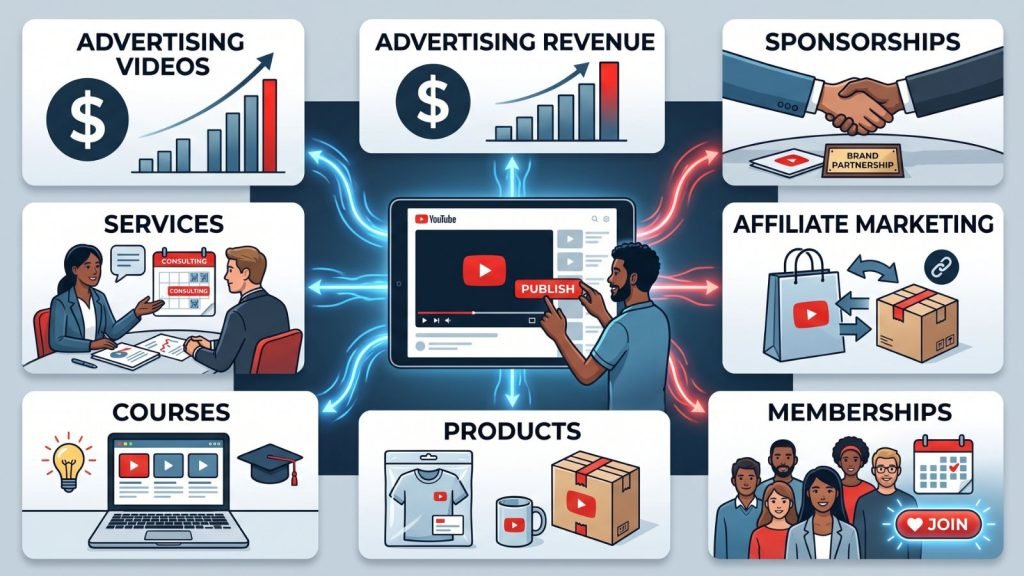
YouTube itself offers several ways to get paid, including advertising revenue, YouTube Premium revenue, channel memberships, Super Thanks, Super Chat, and Shopping. But those are only part of the opportunity.
Creators can also make money from:
- Sponsorships
- Affiliate marketing
- Physical products
- Digital products
- Courses and memberships
- Consulting and services
- Content licensing
- Their own businesses
That means YouTube should not be viewed simply as a platform that pays creators for views. It can be a distribution platform for an entire creator business.
A small channel with the right audience and business model can sometimes be more valuable than a much larger channel that depends entirely on advertising.
Here is how to make money on YouTube, including the requirements you need to know and the revenue streams worth building.
How Many Subscribers Do You Need to Make Money on YouTube?
There are two different answers to this question.
If you want to make money through YouTube’s own monetization tools, you need to qualify for the YouTube Partner Program.
If you want to make money because of your YouTube audience, there is technically no minimum subscriber count. You can sell a service, use affiliate links, find sponsors, or sell your own products before you qualify for YouTube ad revenue.
Current YouTube Partner Program Requirements
As of August 26, 2026, YouTube has two major monetization levels.
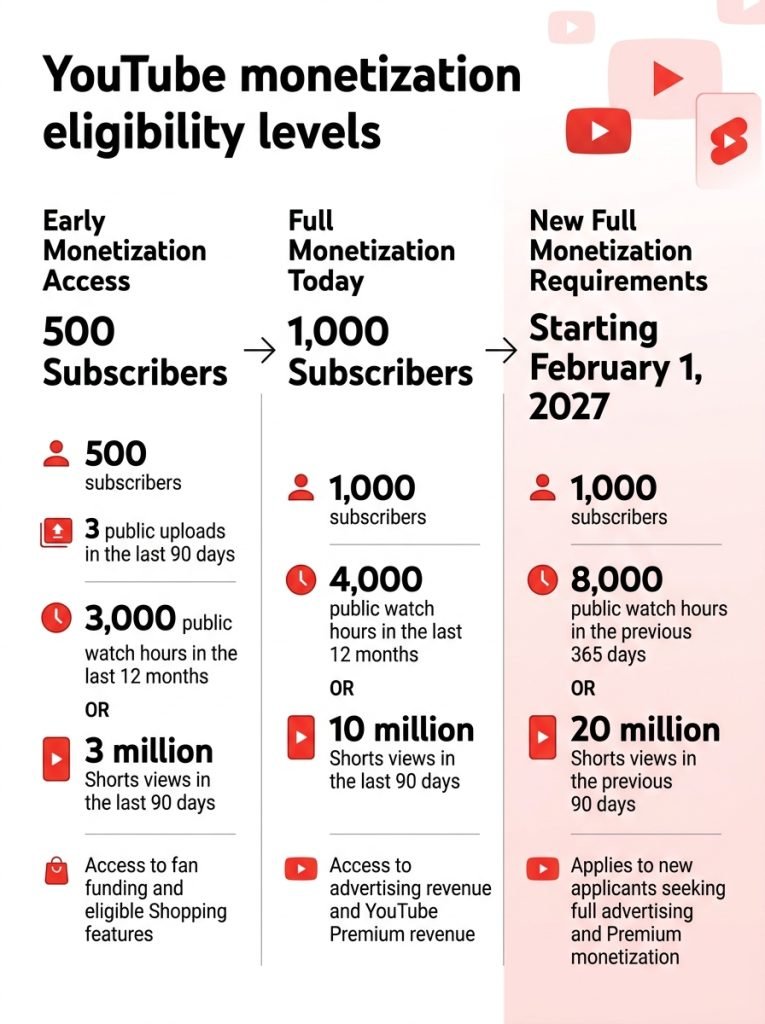
In countries where the expanded YouTube Partner Program is available, creators can get earlier access to features such as channel memberships, Super Chat, Super Stickers, Super Thanks, and certain Shopping features when they have:
- 500 subscribers
- Three valid public uploads in the previous 90 days
- 3,000 qualified public watch hours in the previous 12 months, or
- 3 million qualified Shorts views in the previous 90 days
Full access to advertising and YouTube Premium revenue currently requires:
- 1,000 subscribers
- 4,000 qualified public watch hours in the previous 12 months, or
- 10 million qualified Shorts views in the previous 90 days
Watch time generated inside the Shorts Feed does not count toward the long-form watch-hour requirement. Meeting the numbers also does not guarantee acceptance. YouTube reviews channels for compliance with its monetization policies.
Important YouTube Monetization Change Coming in 2027
YouTube has already announced a significant change for new creators beginning February 1, 2027.
New applicants seeking full advertising and Premium monetization will still need 1,000 subscribers, but the viewing requirements will increase to either:
- 8,000 qualified watch hours during the previous 365 days, or
- 20 million qualified Shorts views during the previous 90 days
Creators who are already in the YouTube Partner Program are not expected to lose their existing YPP status because of the new entry thresholds.
YouTube says the lower requirements for fan funding, Creator Partnerships, and Shopping will remain at 500 subscribers plus either 3,000 qualified watch hours or 3 million qualified Shorts views.
For creators building a channel now, this makes it even more important to think beyond advertising.
1. Make Money From YouTube Ads
Advertising is the revenue stream most people think about when they ask how to make money on YouTube.
Once you qualify for full YPP monetization and accept the appropriate monetization terms, YouTube can place ads around eligible videos.
For traditional videos viewed on a YouTube Watch Page, YouTube currently pays creators 55% of net advertising revenue generated through the Watch Page Monetization Module.
That does not mean every 1,000 views will earn the same amount.
The amount a creator earns from advertising can vary based on factors such as:
- The topic of the video
- Where viewers live
- Advertiser demand
- The time of year
- The types of ads available
- Whether the viewer is shown an ad
- How advertiser-friendly the content is
A finance channel and an entertainment channel receiving the same number of views can generate very different advertising revenue.
This is why creators should pay attention to RPM, or revenue per mille.
YouTube defines RPM as the amount a creator has earned per 1,000 views after YouTube’s revenue share. It can include ads, memberships, YouTube Premium revenue, Super Chat, and Super Stickers.
CPM is different. CPM measures what advertisers pay per 1,000 ad impressions before YouTube’s revenue share. It is not the amount the creator receives.
A simple way to estimate platform revenue is:
Views ÷ 1,000 × RPM = estimated YouTube revenue
For example, if a creator had a $5 RPM, 100,000 views would produce about $500 in revenue.
That is only an example, not a typical or guaranteed YouTube RPM. Actual RPM can be much higher or lower.
2. Make Money From YouTube Shorts
YouTube Shorts can also generate advertising revenue, but Shorts monetization works differently from traditional videos.
Ads appear between videos in the Shorts Feed. YouTube pools eligible Shorts advertising revenue and calculates a Creator Pool based on qualifying views and other factors.
Monetizing creators currently keep 45% of the revenue allocated to them from the Shorts Creator Pool.
That difference is important.
A creator should not assume that one million Shorts views will generate the same income as one million views on traditional long-form videos.
Shorts can still be extremely useful because they can help creators:
- Reach new viewers
- Gain subscribers
- Introduce people to longer videos
- Promote products
- Generate affiliate sales
- Attract sponsors
- Build awareness for a business
In other words, the value of a Short does not have to stop with the Shorts advertising payment.
A creator might use Shorts for discovery and then move viewers toward longer videos, affiliate products, an email list, a membership, or another offer.
That can make Shorts much more valuable than their direct advertising revenue alone.
3. Earn Money From YouTube Premium Viewers
YouTube Premium gives creators another source of platform revenue.
Premium subscribers pay YouTube for benefits such as ad-free viewing. When Premium subscribers watch eligible monetized content, creators can receive a share of subscription revenue.
YouTube says Premium membership revenue is distributed to creators based on how much Premium members watch their content.
Creators do not need to convince viewers to purchase Premium directly.
The key is simply creating videos Premium members want to watch.
This can be easy to overlook because there is no traditional ad being displayed, but Premium viewers can still produce revenue for an eligible channel.
4. Make Money With Channel Memberships, Super Thanks and Live Streams
Advertising pays based largely on audience consumption.
Fan funding allows the audience to pay the creator directly.
Eligible creators can monetize their most loyal viewers using features such as:
- Channel memberships
- Super Chat
- Super Stickers
- Super Thanks
Channel memberships allow viewers to make recurring monthly payments in exchange for benefits selected by the creator.
Those benefits might include exclusive videos, members-only live streams, badges, early access, private posts, or other extras.
Super Chat and Super Stickers allow viewers to pay to highlight messages during eligible live streams and Premieres.
Super Thanks allows viewers to financially support creators on eligible videos and Shorts.
Under YouTube’s Commerce Product Module, creators receive 70% of net revenue from channel memberships, Super Chat, Super Stickers, and Super Thanks.
These features work best when viewers feel connected to the creator rather than simply interested in one individual video.
A tutorial channel that gets most of its traffic from one-time Google searches may have millions of views but relatively weak membership potential.
A channel with fewer views but a highly loyal community may do much better.
Audience loyalty can matter more than audience size when the business model depends on recurring support.
5. Get YouTube Sponsorships and Brand Deals
Sponsorships can become one of the most valuable ways to make money on YouTube.
Instead of receiving money from YouTube, the creator is paid by a company that wants access to the creator’s audience.
A sponsorship might include:
- A short sponsor message inside a video
- A longer product demonstration
- A dedicated sponsored video
- Product placement
- A sponsored Short
- A series of videos
- Usage rights allowing the company to advertise with the creator’s content
Creators do not necessarily need hundreds of thousands of subscribers to get sponsors.
Brands care about whether a creator reaches the people they want to reach.
A small channel focused on commercial real estate software, for example, could be attractive to a software company even if the channel has far fewer viewers than a general entertainment channel.
The market for creator advertising is substantial. The Interactive Advertising Bureau projected that U.S. creator advertising spending would rise from $37 billion in 2025 to approximately $44 billion in 2026.
The best sponsorship opportunities usually come when a creator can clearly explain:
Who watches the channel + what those viewers care about + why the sponsor fits that audience.
Creators should build a simple media kit that includes audience demographics, typical video performance, engagement, previous partnerships, and contact information.
Do not hide sponsorships.
YouTube requires creators to tell the platform when a video includes a paid product placement, sponsorship, endorsement, or other commercial relationship requiring disclosure.
In the United States, the Federal Trade Commission also says material connections between creators and brands should be disclosed clearly and conspicuously. For video endorsements, the FTC recommends making the disclosure in the video rather than relying only on the description.
6. Make Money With Affiliate Marketing
Affiliate marketing is one of the easiest revenue streams to start before a channel qualifies for advertising.
The basic model is simple.
A creator recommends a product or service and provides a trackable affiliate link. If someone buys through that link and the transaction qualifies, the creator receives a commission.
Affiliate marketing works especially well with videos where viewers already have buying intent.
Examples include:
- Product reviews
- Comparisons
- Buying guides
- Tutorials
- Software demonstrations
- Equipment lists
- “Best X for Y” videos
- Setup videos
- Before-and-after demonstrations
Imagine someone searching YouTube for “best microphone for YouTube videos.”
That viewer may be much closer to making a purchase than someone watching a general entertainment video.
A creator could demonstrate several microphones, explain which one is best for different types of creators, and include affiliate links in the description.
The video can then earn money each time it helps produce a qualifying sale.
Some eligible creators can also participate in YouTube Shopping, which allows creators to feature their own products or tag products from other brands directly in videos, Shorts, and live streams. Availability and eligibility vary by country and channel.
Affiliate income can become especially powerful with evergreen videos.
A useful product review might continue ranking in YouTube and Google search for months or years. Instead of producing money once, the video can repeatedly send qualified buyers to an affiliate offer.
Creators also need to disclose affiliate relationships appropriately. FTC guidance says the financial relationship should be made clear, and disclosures should be close enough to the recommendation or affiliate link that viewers are likely to notice them.
7. Sell Your Own Products Through YouTube
Affiliate marketing gives a creator a percentage of somebody else’s sale.
Selling your own product allows you to own the offer.
Physical products might include:
- Clothing
- Books
- Art
- Tools
- Accessories
- Specialty products
- Branded merchandise
YouTube Shopping allows eligible creators to connect supported stores and feature products across parts of the YouTube experience, including videos, Shorts, and live streams.
However, creators should not assume merchandise is automatically the best product.
A general entertainment creator with a loyal fan base might do well selling branded clothing.
An educational creator may have better opportunities selling something directly related to the problem the audience wants solved.
For example, a woodworking creator might sell project plans. A photography creator might sell presets. A cooking creator might sell a cookbook.
The strongest product usually comes from understanding why people watch the channel in the first place.
8. Sell Digital Products, Courses, Memberships or Services
Some of the most profitable YouTube businesses make a large percentage of their money outside YouTube.
Educational and expertise-based creators can use free videos to demonstrate what they know, earn trust, and then offer something more valuable to viewers who want additional help.
Possible offers include:
- Online courses
- Paid communities
- Templates
- Guides
- E-books
- Software
- Newsletters
- Coaching
- Consulting
- Freelance services
Consider a YouTube creator teaching small businesses how to run Facebook ads.
The videos themselves could make advertising revenue, but the creator might also sell a $99 template package, a $500 course, or a consulting package worth several thousand dollars.
That changes the economics of the channel.
The creator no longer needs every view to be worth only a fraction of a cent in advertising revenue. A relatively small number of viewers becoming customers can make a video financially successful.
This is why subscriber count alone is a poor way to measure the business value of a YouTube channel.
A focused audience with an expensive problem can be worth far more than a large audience with little purchase intent.
9. License Your Videos and Content
Creators who capture unusual, newsworthy, educational, or highly shareable footage may be able to license their content.
A media organization, documentary producer, company, or other publisher might pay for permission to use footage.
This revenue stream is less predictable than advertising or memberships, but certain channels are naturally suited to it.
Examples include creators producing:
- Unique wildlife footage
- Extreme weather footage
- Historical archives
- Viral moments
- Specialized demonstrations
- Rare events
- Original research or documentary footage
Creators should keep organized copies of original footage and understand what rights they own before licensing material.
A video does not need millions of subscribers behind it to have licensing value. What matters is whether someone else needs the footage and whether the creator controls the necessary rights.
10. Use YouTube to Grow a Business
The final method is also the broadest.
YouTube itself does not have to be the product.
It can be the marketing engine.
Businesses use YouTube to attract potential customers for everything from software to home remodeling, legal services, online education, real estate, financial services, agencies, and local businesses.
For a business owner, a video that generates only $50 in YouTube advertising revenue could still be extremely valuable if it also produces a $5,000 customer.
This is another reason creators should not judge every video only by AdSense revenue.
Ask a bigger question:
What is this viewer worth to the entire business?
How Much Money Does YouTube Pay Per 1,000 Views?
There is no single amount that YouTube pays for 1,000 views.
Any article claiming that every creator earns a fixed amount per 1,000 views is oversimplifying how YouTube monetization works.
Not every view displays an advertisement. Advertiser demand varies. Viewer location matters. Video topic matters. Seasonality matters. Different ad formats can produce different results.
YouTube’s own analytics documentation explains that RPM can change because of factors such as viewer geography, time of year, ad availability, and the number of views that actually monetize.
Creators should therefore use the RPM inside their own YouTube Analytics rather than relying on somebody else’s claimed average.
There is another important limitation.
YouTube’s RPM does not include many of the revenue streams that can make a creator business valuable, such as merchandise, most sponsorships, consulting, or other income generated indirectly through the channel.
So even RPM does not show the full economic value of a YouTube audience.
A more useful metric for serious creators is:
Total creator business revenue ÷ total YouTube views × 1,000
That can help show the actual amount of business revenue being generated for every 1,000 views.
How to Make Money on YouTube as a Beginner
A beginner should not wait for YouTube advertising before thinking about monetization.
Start by deciding who the channel is for and what that audience spends money on.
A channel about fishing equipment has natural affiliate opportunities.
A channel teaching Excel has opportunities for templates and courses.
A channel about business taxes could potentially generate consulting or professional-service leads.
A comedy channel may be better suited to sponsorships, advertising, merchandise, and memberships.
The audience and the content should shape the monetization model.
Start With One Revenue Stream
Trying to launch ads, a course, merchandise, a community, affiliate links, and consulting at the same time can become a distraction.
Choose the revenue opportunity that best matches why people watch your videos.
Then prove it works.
Once the first revenue stream is producing consistent results, add another.
Create Videos With Commercial Intent
Not every video needs to sell something, but some topics naturally attract viewers who are close to spending money.
A video titled “My Camera Setup” may attract casual curiosity.
A video titled “Best Camera for YouTube Beginners” attracts a viewer actively comparing products.
Both videos might receive the same number of views while producing dramatically different affiliate revenue.
Build an Audience You Understand
Sponsors and customers care about relevance.
A clearly defined audience is easier to monetize because you know what companies want to reach those viewers and what products the viewers are likely to buy.
“Nurses trying to become travel nurses” is easier to build offers around than “people interested in interesting things.”
Specificity can be an advantage.
Create a Revenue Stack
Eventually, successful creators can combine several revenue sources.
For example, one video might generate:
- YouTube advertising revenue.
- YouTube Premium revenue.
- Affiliate commissions.
- Sponsorship revenue.
- Sales of the creator’s own product.
- New paid members.
That is the real power of YouTube monetization.
The same piece of content can participate in several business models at once.
Protect Your Ability to Monetize
Getting enough views and subscribers is only part of qualifying for YouTube monetization.
YouTube also reviews the content itself.
Its current channel monetization policies say monetized content should be original and authentic. YouTube specifically identifies repetitive, mass-produced, generic, or minimally transformed content as potential monetization problems.
The company renamed its previous “repetitious content” policy to “inauthentic content” in July 2025 to clarify that repetitive or mass-produced content was included. YouTube also maintains a separate reused-content policy for channels using material from other sources without enough original commentary, modification, educational value, or entertainment value.
This does not mean creators cannot use AI tools or outside material.
It means the finished channel still needs to provide meaningful original value.
Using AI to help research, edit, or create elements of a video is very different from automatically publishing hundreds of nearly identical videos that offer little original substance.
Creators building a long-term business should optimize for useful, original content that viewers genuinely choose to watch, not simply for producing the greatest possible number of uploads.
Frequently Asked Questions About Making Money on YouTube
Can you make money on YouTube with 500 subscribers?
Yes.
In eligible countries, creators who meet the expanded YPP requirements can gain access to certain fan-funding and Shopping features beginning at 500 subscribers.
Creators can also make money outside YouTube’s built-in monetization system through affiliate marketing, sponsorships, products, and services.
Can you make money on YouTube before 1,000 subscribers?
Yes.
You do not need 1,000 subscribers to use YouTube to generate affiliate sales, sell a product or service, or arrange your own sponsorship.
The 1,000-subscriber requirement applies to the current full YPP level for advertising and YouTube Premium revenue.
Does YouTube pay for Shorts?
Yes.
Eligible monetized creators can earn revenue from ads displayed between videos in the Shorts Feed. Creators currently receive 45% of the Shorts revenue allocated to them through YouTube’s Creator Pool system.
Do you need millions of views to make money on YouTube?
No.
The number of views needed depends heavily on the business model.
A general entertainment channel relying entirely on advertising may need substantial view volume.
A specialized channel selling consulting, software, courses, or expensive products could potentially build a meaningful business with far fewer views.
What is the best way to make money on YouTube?
There is no single best method for every creator.
Advertising works well for channels producing significant view volume. Sponsorships can work for channels with clearly defined audiences. Affiliate marketing works well for product-focused and tutorial content. Products and services can work especially well for educational and expertise-based creators.
For many established creators, the strongest model is a combination of several revenue streams rather than dependence on one.
Can you make money on YouTube without showing your face?
Yes.
A creator does not have to appear on camera to monetize a YouTube channel.
Tutorials, documentaries, animation, screen recordings, educational videos, original narration, and many other formats can work without an on-camera host.
However, faceless does not mean low-effort or copied. YouTube’s monetization policies still require eligible content to meet its originality and authenticity standards.
The Real Way to Make Money on YouTube
The biggest lesson is simple.
Do not build a YouTube channel around one source of income. Build an audience and then give that audience several appropriate ways to create revenue.
Advertising can provide a foundation.
Shorts can bring discovery.
Memberships can monetize loyalty.
Sponsors can pay for access to a specific audience.
Affiliate links can monetize purchase intent.
Products and services can turn viewers into customers.
YouTube gives creators something extremely valuable: distribution.
The creators who build the strongest businesses learn how to turn that distribution into more than views.
They turn it into attention, trust, customers, and multiple sources of income.
Sources
Primary Sources
YouTube Help: YouTube Partner Program Overview & Eligibility
URL: YouTube Partner Program overview and eligibility
Supported: Current 1,000-subscriber YPP requirements, qualified watch hours, qualified Shorts views, application requirements, and review process.
Publication date: Not listed
Access date: August 26, 2026
YouTube Help: Overview of the Expanded YouTube Partner Program
URL: Expanded YouTube Partner Program requirements
Supported: 500-subscriber early-access requirements and available monetization features.
Publication date: Not listed
Access date: August 26, 2026
YouTube Help: Changes to the YouTube Partner Program
URL: Upcoming YouTube Partner Program changes
Supported: February 1, 2027 YPP threshold changes and continued lower thresholds for fan funding and Shopping.
Publication date: Updated August 2026
Access date: August 26, 2026
YouTube Help: YouTube Partner Earnings Overview
URL: YouTube partner earnings overview
Supported: 55% Watch Page advertising share, 45% Shorts share, and 70% Commerce Product Module revenue share.
Publication date: Not listed
Access date: August 26, 2026
YouTube Help: Understand Ad Revenue Analytics
URL: YouTube RPM and CPM documentation
Supported: RPM and CPM definitions, factors affecting monetization, and revenue not included in RPM.
Publication date: Not listed
Access date: August 26, 2026
YouTube Help: YouTube Channel Monetization Policies
URL: YouTube channel monetization policies
Supported: Original and authentic content requirements, inauthentic content rules, reused-content policies, and the July 2025 policy clarification.
Publication date: Updated July 15, 2025
Access date: August 26, 2026
YouTube Help: Get Started With Shopping on YouTube
URL: YouTube Shopping eligibility and features
Supported: Selling a creator’s products and promoting products from other brands through YouTube Shopping.
Publication date: Not listed
Access date: August 26, 2026
YouTube Help: Paid Product Placements, Sponsorships & Endorsements
URL: YouTube paid promotion requirements
Supported: YouTube requirements for declaring sponsorships, endorsements, and paid product placements.
Publication date: Not listed
Access date: August 26, 2026
Federal Trade Commission: Disclosures 101 for Social Media Influencers
URL: FTC Disclosures 101 for Social Media Influencers
Supported: Disclosure requirements and guidance for sponsorships, free products, and material relationships with brands.
Publication date: November 2019
Access date: August 26, 2026
Third-Party Sources
Interactive Advertising Bureau: 2025 Creator Economy Ad Spend & Strategy Report
URL: IAB Creator Economy Ad Spend & Strategy Report
Supported: U.S. creator advertising spending of $37 billion in 2025 and projected spending of approximately $44 billion in 2026.
Publication date: November 20, 2025
Access date: August 26, 2026